

LongProc: Benchmarking Long-Context Language Models on Long Procedural Generation
Paper
•
2501.05414
•
Published
•
2
id
stringlengths 16
18
| input_prompt
stringlengths 16.4k
16.4k
| reference_output
stringlengths 881
1.4k
| metadata
stringlengths 94
104
|
|---|---|---|---|
countdown_0.5k_0
|
[TASK]
You will be given four numbers and a target number, your task is to find a way to use all four numbers exactly once, along with the basic operations (+, -, *, /), to reach the target number.
[RULES]
- You can use each number exactly once.
- You can use the four basic operations (+, -, *, /).
- The intermediate results must be integers (no decimals allowed).
- The intermediate results must be positive.
- The intermediate results will not exceed 2000.
[APPROACH]
We will solve the problem by searching. Starting from a given set of four numbers, we will follow this search process:
- At each state, we will consider all possible number pairs (in order) from the current number set. Choose one pair and apply one of the four basic operations to them to obtain a new number.
* If there are still numbers left, we will add the new number to the number set and continue the search.
* If we have used all numbers, we will check if the new number is equal to the target number. If it is, we have found the solution. Otherwise, we will backtrack.
- Suppose the two numbers we choose are a and b (where a >= b). We will try the four options (a + b), (a - b), (a * b), (a / b) to obtain the new number. Remember to always use the larger number as the first operand.
- If the new number is a decimal, or exceeds the maximum intermediate result, we will discard this branch and backtrack.
- We will continue this process until we reach the target number with four numbers used or exhaust all possible combinations.
[EXAMPLES]
# Example
Numbers: [40, 19, 23, 7]
Target: 29
# Search Procedure
Initial number set: [40, 19, 23, 7], target: 29. Options for choosing two numbers: [(40, 19), (40, 23), (40, 7), (19, 23), (19, 7), (23, 7)].
|- Pick two numbers (40, 19) (numbers left: [23, 7]). Try possible operations.
|- Try 40 + 19 = 59. Add 59 to the number set. Current number set: [59, 23, 7], target: 29. Options for choosing two numbers: [(59, 23), (59, 7), (23, 7)].
|- Pick two numbers (59, 23) (numbers left: [7]). Try possible operations.
|- Try 59 + 23 = 82. Add 82 to the number set. Current number set: [82, 7], target: 29, just two numbers left.
|- Try 82 + 7 = 89. Evaluate 89 != 29, drop this branch.
|- Try 82 - 7 = 75. Evaluate 75 != 29, drop this branch.
|- Try 82 * 7 = 574. Evaluate 574 != 29, drop this branch.
|- Try 82 / 7 = 11.7. 11.7 is a decimal, drop this branch.
|- Try 59 - 23 = 36. Add 36 to the number set. Current number set: [36, 7], target: 29, just two numbers left.
|- Try 36 + 7 = 43. Evaluate 43 != 29, drop this branch.
|- Try 36 - 7 = 29. Evaluate 29 == 29, target found!
Now we have found the target, let's trace back the solution:
Final step: 36 - 7 = 29
The step before: 59 - 23 = 36
The first step: 40 + 19 = 59
Output the solution in the required format:
<Solution>
40 + 19 = 59
59 - 23 = 36
36 - 7 = 29
</Solution>
# Example
Numbers: [9, 16, 6, 18]
Target: 12
# Search Procedure
Initial number set: [9, 16, 6, 18], target: 12. Options for choosing two numbers: [(9, 16), (9, 6), (9, 18), (16, 6), (16, 18), (6, 18)].
|- Pick two numbers (9, 16) (numbers left: [6, 18]). Try possible operations.
|- Try 16 + 9 = 25. Add 25 to the number set. Current number set: [25, 6, 18], target: 12. Options for choosing two numbers: [(25, 6), (25, 18), (6, 18)].
|- Pick two numbers (25, 6) (numbers left: [18]). Try possible operations.
|- Try 25 + 6 = 31. Add 31 to the number set. Current number set: [31, 18], target: 12, just two numbers left.
|- Try 31 + 18 = 49. Evaluate 49 != 12, drop this branch.
|- Try 31 - 18 = 13. Evaluate 13 != 12, drop this branch.
|- Try 31 * 18 = 558. Evaluate 558 != 12, drop this branch.
|- Try 31 / 18 = 1.7. 1.7 is a decimal, drop this branch.
|- Try 25 - 6 = 19. Add 19 to the number set. Current number set: [19, 18], target: 12, just two numbers left.
|- Try 19 + 18 = 37. Evaluate 37 != 12, drop this branch.
|- Try 19 - 18 = 1. Evaluate 1 != 12, drop this branch.
|- Try 19 * 18 = 342. Evaluate 342 != 12, drop this branch.
|- Try 19 / 18 = 1.1. 1.1 is a decimal, drop this branch.
|- Try 25 * 6 = 150. Add 150 to the number set. Current number set: [150, 18], target: 12, just two numbers left.
|- Try 150 + 18 = 168. Evaluate 168 != 12, drop this branch.
|- Try 150 - 18 = 132. Evaluate 132 != 12, drop this branch.
|- Try 150 * 18 = 2700. 2700 exceeds the maximum intermediate result, drop this branch.
|- Try 150 / 18 = 8.3. 8.3 is a decimal, drop this branch.
|- Try 25 / 6 = 4.2. 4.2 is a decimal, drop this branch.
|- Pick two numbers (25, 18) (numbers left: [6]). Try possible operations.
|- Try 25 + 18 = 43. Add 43 to the number set. Current number set: [43, 6], target: 12, just two numbers left.
|- Try 43 + 6 = 49. Evaluate 49 != 12, drop this branch.
|- Try 43 - 6 = 37. Evaluate 37 != 12, drop this branch.
|- Try 43 * 6 = 258. Evaluate 258 != 12, drop this branch.
|- Try 43 / 6 = 7.2. 7.2 is a decimal, drop this branch.
|- Try 25 - 18 = 7. Add 7 to the number set. Current number set: [7, 6], target: 12, just two numbers left.
|- Try 7 + 6 = 13. Evaluate 13 != 12, drop this branch.
|- Try 7 - 6 = 1. Evaluate 1 != 12, drop this branch.
|- Try 7 * 6 = 42. Evaluate 42 != 12, drop this branch.
|- Try 7 / 6 = 1.2. 1.2 is a decimal, drop this branch.
|- Try 25 * 18 = 450. Add 450 to the number set. Current number set: [450, 6], target: 12, just two numbers left.
|- Try 450 + 6 = 456. Evaluate 456 != 12, drop this branch.
|- Try 450 - 6 = 444. Evaluate 444 != 12, drop this branch.
|- Try 450 * 6 = 2700. 2700 exceeds the maximum intermediate result, drop this branch.
|- Try 450 / 6 = 75. Evaluate 75 != 12, drop this branch.
|- Try 25 / 18 = 1.4. 1.4 is a decimal, drop this branch.
|- Pick two numbers (6, 18) (numbers left: [25]). Try possible operations.
|- Try 18 + 6 = 24. Add 24 to the number set. Current number set: [24, 25], target: 12, just two numbers left.
|- Try 25 + 24 = 49. Evaluate 49 != 12, drop this branch.
|- Try 25 - 24 = 1. Evaluate 1 != 12, drop this branch.
|- Try 25 * 24 = 600. Evaluate 600 != 12, drop this branch.
|- Try 25 / 24 = 1.0. 1.0 is a decimal, drop this branch.
|- Try 18 - 6 = 12. Add 12 to the number set. Current number set: [12, 25], target: 12, just two numbers left.
|- Try 25 + 12 = 37. Evaluate 37 != 12, drop this branch.
|- Try 25 - 12 = 13. Evaluate 13 != 12, drop this branch.
|- Try 25 * 12 = 300. Evaluate 300 != 12, drop this branch.
|- Try 25 / 12 = 2.1. 2.1 is a decimal, drop this branch.
|- Try 18 * 6 = 108. Add 108 to the number set. Current number set: [108, 25], target: 12, just two numbers left.
|- Try 108 + 25 = 133. Evaluate 133 != 12, drop this branch.
|- Try 108 - 25 = 83. Evaluate 83 != 12, drop this branch.
|- Try 108 * 25 = 2700. 2700 exceeds the maximum intermediate result, drop this branch.
|- Try 108 / 25 = 4.3. 4.3 is a decimal, drop this branch.
|- Try 18 / 6 = 3. Add 3 to the number set. Current number set: [3, 25], target: 12, just two numbers left.
|- Try 25 + 3 = 28. Evaluate 28 != 12, drop this branch.
|- Try 25 - 3 = 22. Evaluate 22 != 12, drop this branch.
|- Try 25 * 3 = 75. Evaluate 75 != 12, drop this branch.
|- Try 25 / 3 = 8.3. 8.3 is a decimal, drop this branch.
|- Try 16 - 9 = 7. Add 7 to the number set. Current number set: [7, 6, 18], target: 12. Options for choosing two numbers: [(7, 6), (7, 18), (6, 18)].
|- Pick two numbers (7, 6) (numbers left: [18]). Try possible operations.
|- Try 7 + 6 = 13. Add 13 to the number set. Current number set: [13, 18], target: 12, just two numbers left.
|- Try 18 + 13 = 31. Evaluate 31 != 12, drop this branch.
|- Try 18 - 13 = 5. Evaluate 5 != 12, drop this branch.
|- Try 18 * 13 = 234. Evaluate 234 != 12, drop this branch.
|- Try 18 / 13 = 1.4. 1.4 is a decimal, drop this branch.
|- Try 7 - 6 = 1. Add 1 to the number set. Current number set: [1, 18], target: 12, just two numbers left.
|- Try 18 + 1 = 19. Evaluate 19 != 12, drop this branch.
|- Try 18 - 1 = 17. Evaluate 17 != 12, drop this branch.
|- Try 18 * 1 = 18. Evaluate 18 != 12, drop this branch.
|- Try 18 / 1 = 18. Evaluate 18 != 12, drop this branch.
|- Try 7 * 6 = 42. Add 42 to the number set. Current number set: [42, 18], target: 12, just two numbers left.
|- Try 42 + 18 = 60. Evaluate 60 != 12, drop this branch.
|- Try 42 - 18 = 24. Evaluate 24 != 12, drop this branch.
|- Try 42 * 18 = 756. Evaluate 756 != 12, drop this branch.
|- Try 42 / 18 = 2.3. 2.3 is a decimal, drop this branch.
|- Try 7 / 6 = 1.2. 1.2 is a decimal, drop this branch.
|- Pick two numbers (7, 18) (numbers left: [6]). Try possible operations.
|- Try 18 + 7 = 25. Add 25 to the number set. Current number set: [25, 6], target: 12, just two numbers left.
|- Try 25 + 6 = 31. Evaluate 31 != 12, drop this branch.
|- Try 25 - 6 = 19. Evaluate 19 != 12, drop this branch.
|- Try 25 * 6 = 150. Evaluate 150 != 12, drop this branch.
|- Try 25 / 6 = 4.2. 4.2 is a decimal, drop this branch.
|- Try 18 - 7 = 11. Add 11 to the number set. Current number set: [11, 6], target: 12, just two numbers left.
|- Try 11 + 6 = 17. Evaluate 17 != 12, drop this branch.
|- Try 11 - 6 = 5. Evaluate 5 != 12, drop this branch.
|- Try 11 * 6 = 66. Evaluate 66 != 12, drop this branch.
|- Try 11 / 6 = 1.8. 1.8 is a decimal, drop this branch.
|- Try 18 * 7 = 126. Add 126 to the number set. Current number set: [126, 6], target: 12, just two numbers left.
|- Try 126 + 6 = 132. Evaluate 132 != 12, drop this branch.
|- Try 126 - 6 = 120. Evaluate 120 != 12, drop this branch.
|- Try 126 * 6 = 756. Evaluate 756 != 12, drop this branch.
|- Try 126 / 6 = 21. Evaluate 21 != 12, drop this branch.
|- Try 18 / 7 = 2.6. 2.6 is a decimal, drop this branch.
|- Pick two numbers (6, 18) (numbers left: [7]). Try possible operations.
|- Try 18 + 6 = 24. Add 24 to the number set. Current number set: [24, 7], target: 12, just two numbers left.
|- Try 24 + 7 = 31. Evaluate 31 != 12, drop this branch.
|- Try 24 - 7 = 17. Evaluate 17 != 12, drop this branch.
|- Try 24 * 7 = 168. Evaluate 168 != 12, drop this branch.
|- Try 24 / 7 = 3.4. 3.4 is a decimal, drop this branch.
|- Try 18 - 6 = 12. Add 12 to the number set. Current number set: [12, 7], target: 12, just two numbers left.
|- Try 12 + 7 = 19. Evaluate 19 != 12, drop this branch.
|- Try 12 - 7 = 5. Evaluate 5 != 12, drop this branch.
|- Try 12 * 7 = 84. Evaluate 84 != 12, drop this branch.
|- Try 12 / 7 = 1.7. 1.7 is a decimal, drop this branch.
|- Try 18 * 6 = 108. Add 108 to the number set. Current number set: [108, 7], target: 12, just two numbers left.
|- Try 108 + 7 = 115. Evaluate 115 != 12, drop this branch.
|- Try 108 - 7 = 101. Evaluate 101 != 12, drop this branch.
|- Try 108 * 7 = 756. Evaluate 756 != 12, drop this branch.
|- Try 108 / 7 = 15.4. 15.4 is a decimal, drop this branch.
|- Try 18 / 6 = 3. Add 3 to the number set. Current number set: [3, 7], target: 12, just two numbers left.
|- Try 7 + 3 = 10. Evaluate 10 != 12, drop this branch.
|- Try 7 - 3 = 4. Evaluate 4 != 12, drop this branch.
|- Try 7 * 3 = 21. Evaluate 21 != 12, drop this branch.
|- Try 7 / 3 = 2.3. 2.3 is a decimal, drop this branch.
|- Try 16 * 9 = 144. Add 144 to the number set. Current number set: [144, 6, 18], target: 12. Options for choosing two numbers: [(144, 6), (144, 18), (6, 18)].
|- Pick two numbers (144, 6) (numbers left: [18]). Try possible operations.
|- Try 144 + 6 = 150. Add 150 to the number set. Current number set: [150, 18], target: 12, just two numbers left.
|- Try 150 + 18 = 168. Evaluate 168 != 12, drop this branch.
|- Try 150 - 18 = 132. Evaluate 132 != 12, drop this branch.
|- Try 150 * 18 = 2700. 2700 exceeds the maximum intermediate result, drop this branch.
|- Try 150 / 18 = 8.3. 8.3 is a decimal, drop this branch.
|- Try 144 - 6 = 138. Add 138 to the number set. Current number set: [138, 18], target: 12, just two numbers left.
|- Try 138 + 18 = 156. Evaluate 156 != 12, drop this branch.
|- Try 138 - 18 = 120. Evaluate 120 != 12, drop this branch.
|- Try 138 * 18 = 2484. 2484 exceeds the maximum intermediate result, drop this branch.
|- Try 138 / 18 = 7.7. 7.7 is a decimal, drop this branch.
|- Try 144 * 6 = 864. Add 864 to the number set. Current number set: [864, 18], target: 12, just two numbers left.
|- Try 864 + 18 = 882. Evaluate 882 != 12, drop this branch.
|- Try 864 - 18 = 846. Evaluate 846 != 12, drop this branch.
|- Try 864 * 18 = 15552. 15552 exceeds the maximum intermediate result, drop this branch.
|- Try 864 / 18 = 48. Evaluate 48 != 12, drop this branch.
|- Try 144 / 6 = 24. Add 24 to the number set. Current number set: [24, 18], target: 12, just two numbers left.
|- Try 24 + 18 = 42. Evaluate 42 != 12, drop this branch.
|- Try 24 - 18 = 6. Evaluate 6 != 12, drop this branch.
|- Try 24 * 18 = 432. Evaluate 432 != 12, drop this branch.
|- Try 24 / 18 = 1.3. 1.3 is a decimal, drop this branch.
|- Pick two numbers (144, 18) (numbers left: [6]). Try possible operations.
|- Try 144 + 18 = 162. Add 162 to the number set. Current number set: [162, 6], target: 12, just two numbers left.
|- Try 162 + 6 = 168. Evaluate 168 != 12, drop this branch.
|- Try 162 - 6 = 156. Evaluate 156 != 12, drop this branch.
|- Try 162 * 6 = 972. Evaluate 972 != 12, drop this branch.
|- Try 162 / 6 = 27. Evaluate 27 != 12, drop this branch.
|- Try 144 - 18 = 126. Add 126 to the number set. Current number set: [126, 6], target: 12, just two numbers left.
|- Try 126 + 6 = 132. Evaluate 132 != 12, drop this branch.
|- Try 126 - 6 = 120. Evaluate 120 != 12, drop this branch.
|- Try 126 * 6 = 756. Evaluate 756 != 12, drop this branch.
|- Try 126 / 6 = 21. Evaluate 21 != 12, drop this branch.
|- Try 144 * 18 = 2592. 2592 exceeds the maximum intermediate result, drop this branch.
|- Try 144 / 18 = 8. Add 8 to the number set. Current number set: [8, 6], target: 12, just two numbers left.
|- Try 8 + 6 = 14. Evaluate 14 != 12, drop this branch.
|- Try 8 - 6 = 2. Evaluate 2 != 12, drop this branch.
|- Try 8 * 6 = 48. Evaluate 48 != 12, drop this branch.
|- Try 8 / 6 = 1.3. 1.3 is a decimal, drop this branch.
|- Pick two numbers (6, 18) (numbers left: [144]). Try possible operations.
|- Try 18 + 6 = 24. Add 24 to the number set. Current number set: [24, 144], target: 12, just two numbers left.
|- Try 144 + 24 = 168. Evaluate 168 != 12, drop this branch.
|- Try 144 - 24 = 120. Evaluate 120 != 12, drop this branch.
|- Try 144 * 24 = 3456. 3456 exceeds the maximum intermediate result, drop this branch.
|- Try 144 / 24 = 6. Evaluate 6 != 12, drop this branch.
|- Try 18 - 6 = 12. Add 12 to the number set. Current number set: [12, 144], target: 12, just two numbers left.
|- Try 144 + 12 = 156. Evaluate 156 != 12, drop this branch.
|- Try 144 - 12 = 132. Evaluate 132 != 12, drop this branch.
|- Try 144 * 12 = 1728. Evaluate 1728 != 12, drop this branch.
|- Try 144 / 12 = 12. Evaluate 12 == 12, target found!
Now we have found the target, let's trace back the solution:
Final step: 144 / 12 = 12
The step before: 18 - 6 = 12
The first step: 16 * 9 = 144
Output the solution in the required format:
<Solution>
16 * 9 = 144
18 - 6 = 12
144 / 12 = 12
</Solution>
[Problem]
Now, solve the following problem. Note that:
- Please carefully read the approach and examples provided above, and follow them to solve the problem.
- Please ALWAYS include your search procedure (after # Search Procedure). The search procedure should follow the format of the examples provided above.
- Please mark your answer with <Solution> and </Solution> tags. The solution should be a sequence of three equations exactly following the format of the examples above, with no additional text in between.
Numbers: [21, 16, 17, 26]
Target: 46
|
# Search Procedure
Initial number set: [21, 16, 17, 26], target: 46. Options for choosing two numbers: [(21, 16), (21, 17), (21, 26), (16, 17), (16, 26), (17, 26)].
|- Pick two numbers (21, 16) (numbers left: [17, 26]). Try possible operations.
|- Try 21 + 16 = 37. Add 37 to the number set. Current number set: [37, 17, 26], target: 46. Options for choosing two numbers: [(37, 17), (37, 26), (17, 26)].
|- Pick two numbers (37, 17) (numbers left: [26]). Try possible operations.
|- Try 37 + 17 = 54. Add 54 to the number set. Current number set: [54, 26], target: 46, just two numbers left.
|- Try 54 + 26 = 80. Evaluate 80 != 46, drop this branch.
|- Try 54 - 26 = 28. Evaluate 28 != 46, drop this branch.
|- Try 54 * 26 = 1404. Evaluate 1404 != 46, drop this branch.
|- Try 54 / 26 = 2.1. 2.1 is a decimal, drop this branch.
|- Try 37 - 17 = 20. Add 20 to the number set. Current number set: [20, 26], target: 46, just two numbers left.
|- Try 26 + 20 = 46. Evaluate 46 == 46, target found!
Now we have found the target, let's trace back the solution:
Final step: 26 + 20 = 46
The step before: 37 - 17 = 20
The first step: 21 + 16 = 37
Output the solution in the required format:
<Solution>
21 + 16 = 37
37 - 17 = 20
26 + 20 = 46
</Solution>
|
{"nums": [21, 16, 17, 26], "target": 46, "solution": ["21 + 16 = 37", "37 - 17 = 20", "26 + 20 = 46"]}
|
countdown_0.5k_1
|
[TASK]
You will be given four numbers and a target number, your task is to find a way to use all four numbers exactly once, along with the basic operations (+, -, *, /), to reach the target number.
[RULES]
- You can use each number exactly once.
- You can use the four basic operations (+, -, *, /).
- The intermediate results must be integers (no decimals allowed).
- The intermediate results must be positive.
- The intermediate results will not exceed 2000.
[APPROACH]
We will solve the problem by searching. Starting from a given set of four numbers, we will follow this search process:
- At each state, we will consider all possible number pairs (in order) from the current number set. Choose one pair and apply one of the four basic operations to them to obtain a new number.
* If there are still numbers left, we will add the new number to the number set and continue the search.
* If we have used all numbers, we will check if the new number is equal to the target number. If it is, we have found the solution. Otherwise, we will backtrack.
- Suppose the two numbers we choose are a and b (where a >= b). We will try the four options (a + b), (a - b), (a * b), (a / b) to obtain the new number. Remember to always use the larger number as the first operand.
- If the new number is a decimal, or exceeds the maximum intermediate result, we will discard this branch and backtrack.
- We will continue this process until we reach the target number with four numbers used or exhaust all possible combinations.
[EXAMPLES]
# Example
Numbers: [40, 19, 23, 7]
Target: 29
# Search Procedure
Initial number set: [40, 19, 23, 7], target: 29. Options for choosing two numbers: [(40, 19), (40, 23), (40, 7), (19, 23), (19, 7), (23, 7)].
|- Pick two numbers (40, 19) (numbers left: [23, 7]). Try possible operations.
|- Try 40 + 19 = 59. Add 59 to the number set. Current number set: [59, 23, 7], target: 29. Options for choosing two numbers: [(59, 23), (59, 7), (23, 7)].
|- Pick two numbers (59, 23) (numbers left: [7]). Try possible operations.
|- Try 59 + 23 = 82. Add 82 to the number set. Current number set: [82, 7], target: 29, just two numbers left.
|- Try 82 + 7 = 89. Evaluate 89 != 29, drop this branch.
|- Try 82 - 7 = 75. Evaluate 75 != 29, drop this branch.
|- Try 82 * 7 = 574. Evaluate 574 != 29, drop this branch.
|- Try 82 / 7 = 11.7. 11.7 is a decimal, drop this branch.
|- Try 59 - 23 = 36. Add 36 to the number set. Current number set: [36, 7], target: 29, just two numbers left.
|- Try 36 + 7 = 43. Evaluate 43 != 29, drop this branch.
|- Try 36 - 7 = 29. Evaluate 29 == 29, target found!
Now we have found the target, let's trace back the solution:
Final step: 36 - 7 = 29
The step before: 59 - 23 = 36
The first step: 40 + 19 = 59
Output the solution in the required format:
<Solution>
40 + 19 = 59
59 - 23 = 36
36 - 7 = 29
</Solution>
# Example
Numbers: [9, 16, 6, 18]
Target: 12
# Search Procedure
Initial number set: [9, 16, 6, 18], target: 12. Options for choosing two numbers: [(9, 16), (9, 6), (9, 18), (16, 6), (16, 18), (6, 18)].
|- Pick two numbers (9, 16) (numbers left: [6, 18]). Try possible operations.
|- Try 16 + 9 = 25. Add 25 to the number set. Current number set: [25, 6, 18], target: 12. Options for choosing two numbers: [(25, 6), (25, 18), (6, 18)].
|- Pick two numbers (25, 6) (numbers left: [18]). Try possible operations.
|- Try 25 + 6 = 31. Add 31 to the number set. Current number set: [31, 18], target: 12, just two numbers left.
|- Try 31 + 18 = 49. Evaluate 49 != 12, drop this branch.
|- Try 31 - 18 = 13. Evaluate 13 != 12, drop this branch.
|- Try 31 * 18 = 558. Evaluate 558 != 12, drop this branch.
|- Try 31 / 18 = 1.7. 1.7 is a decimal, drop this branch.
|- Try 25 - 6 = 19. Add 19 to the number set. Current number set: [19, 18], target: 12, just two numbers left.
|- Try 19 + 18 = 37. Evaluate 37 != 12, drop this branch.
|- Try 19 - 18 = 1. Evaluate 1 != 12, drop this branch.
|- Try 19 * 18 = 342. Evaluate 342 != 12, drop this branch.
|- Try 19 / 18 = 1.1. 1.1 is a decimal, drop this branch.
|- Try 25 * 6 = 150. Add 150 to the number set. Current number set: [150, 18], target: 12, just two numbers left.
|- Try 150 + 18 = 168. Evaluate 168 != 12, drop this branch.
|- Try 150 - 18 = 132. Evaluate 132 != 12, drop this branch.
|- Try 150 * 18 = 2700. 2700 exceeds the maximum intermediate result, drop this branch.
|- Try 150 / 18 = 8.3. 8.3 is a decimal, drop this branch.
|- Try 25 / 6 = 4.2. 4.2 is a decimal, drop this branch.
|- Pick two numbers (25, 18) (numbers left: [6]). Try possible operations.
|- Try 25 + 18 = 43. Add 43 to the number set. Current number set: [43, 6], target: 12, just two numbers left.
|- Try 43 + 6 = 49. Evaluate 49 != 12, drop this branch.
|- Try 43 - 6 = 37. Evaluate 37 != 12, drop this branch.
|- Try 43 * 6 = 258. Evaluate 258 != 12, drop this branch.
|- Try 43 / 6 = 7.2. 7.2 is a decimal, drop this branch.
|- Try 25 - 18 = 7. Add 7 to the number set. Current number set: [7, 6], target: 12, just two numbers left.
|- Try 7 + 6 = 13. Evaluate 13 != 12, drop this branch.
|- Try 7 - 6 = 1. Evaluate 1 != 12, drop this branch.
|- Try 7 * 6 = 42. Evaluate 42 != 12, drop this branch.
|- Try 7 / 6 = 1.2. 1.2 is a decimal, drop this branch.
|- Try 25 * 18 = 450. Add 450 to the number set. Current number set: [450, 6], target: 12, just two numbers left.
|- Try 450 + 6 = 456. Evaluate 456 != 12, drop this branch.
|- Try 450 - 6 = 444. Evaluate 444 != 12, drop this branch.
|- Try 450 * 6 = 2700. 2700 exceeds the maximum intermediate result, drop this branch.
|- Try 450 / 6 = 75. Evaluate 75 != 12, drop this branch.
|- Try 25 / 18 = 1.4. 1.4 is a decimal, drop this branch.
|- Pick two numbers (6, 18) (numbers left: [25]). Try possible operations.
|- Try 18 + 6 = 24. Add 24 to the number set. Current number set: [24, 25], target: 12, just two numbers left.
|- Try 25 + 24 = 49. Evaluate 49 != 12, drop this branch.
|- Try 25 - 24 = 1. Evaluate 1 != 12, drop this branch.
|- Try 25 * 24 = 600. Evaluate 600 != 12, drop this branch.
|- Try 25 / 24 = 1.0. 1.0 is a decimal, drop this branch.
|- Try 18 - 6 = 12. Add 12 to the number set. Current number set: [12, 25], target: 12, just two numbers left.
|- Try 25 + 12 = 37. Evaluate 37 != 12, drop this branch.
|- Try 25 - 12 = 13. Evaluate 13 != 12, drop this branch.
|- Try 25 * 12 = 300. Evaluate 300 != 12, drop this branch.
|- Try 25 / 12 = 2.1. 2.1 is a decimal, drop this branch.
|- Try 18 * 6 = 108. Add 108 to the number set. Current number set: [108, 25], target: 12, just two numbers left.
|- Try 108 + 25 = 133. Evaluate 133 != 12, drop this branch.
|- Try 108 - 25 = 83. Evaluate 83 != 12, drop this branch.
|- Try 108 * 25 = 2700. 2700 exceeds the maximum intermediate result, drop this branch.
|- Try 108 / 25 = 4.3. 4.3 is a decimal, drop this branch.
|- Try 18 / 6 = 3. Add 3 to the number set. Current number set: [3, 25], target: 12, just two numbers left.
|- Try 25 + 3 = 28. Evaluate 28 != 12, drop this branch.
|- Try 25 - 3 = 22. Evaluate 22 != 12, drop this branch.
|- Try 25 * 3 = 75. Evaluate 75 != 12, drop this branch.
|- Try 25 / 3 = 8.3. 8.3 is a decimal, drop this branch.
|- Try 16 - 9 = 7. Add 7 to the number set. Current number set: [7, 6, 18], target: 12. Options for choosing two numbers: [(7, 6), (7, 18), (6, 18)].
|- Pick two numbers (7, 6) (numbers left: [18]). Try possible operations.
|- Try 7 + 6 = 13. Add 13 to the number set. Current number set: [13, 18], target: 12, just two numbers left.
|- Try 18 + 13 = 31. Evaluate 31 != 12, drop this branch.
|- Try 18 - 13 = 5. Evaluate 5 != 12, drop this branch.
|- Try 18 * 13 = 234. Evaluate 234 != 12, drop this branch.
|- Try 18 / 13 = 1.4. 1.4 is a decimal, drop this branch.
|- Try 7 - 6 = 1. Add 1 to the number set. Current number set: [1, 18], target: 12, just two numbers left.
|- Try 18 + 1 = 19. Evaluate 19 != 12, drop this branch.
|- Try 18 - 1 = 17. Evaluate 17 != 12, drop this branch.
|- Try 18 * 1 = 18. Evaluate 18 != 12, drop this branch.
|- Try 18 / 1 = 18. Evaluate 18 != 12, drop this branch.
|- Try 7 * 6 = 42. Add 42 to the number set. Current number set: [42, 18], target: 12, just two numbers left.
|- Try 42 + 18 = 60. Evaluate 60 != 12, drop this branch.
|- Try 42 - 18 = 24. Evaluate 24 != 12, drop this branch.
|- Try 42 * 18 = 756. Evaluate 756 != 12, drop this branch.
|- Try 42 / 18 = 2.3. 2.3 is a decimal, drop this branch.
|- Try 7 / 6 = 1.2. 1.2 is a decimal, drop this branch.
|- Pick two numbers (7, 18) (numbers left: [6]). Try possible operations.
|- Try 18 + 7 = 25. Add 25 to the number set. Current number set: [25, 6], target: 12, just two numbers left.
|- Try 25 + 6 = 31. Evaluate 31 != 12, drop this branch.
|- Try 25 - 6 = 19. Evaluate 19 != 12, drop this branch.
|- Try 25 * 6 = 150. Evaluate 150 != 12, drop this branch.
|- Try 25 / 6 = 4.2. 4.2 is a decimal, drop this branch.
|- Try 18 - 7 = 11. Add 11 to the number set. Current number set: [11, 6], target: 12, just two numbers left.
|- Try 11 + 6 = 17. Evaluate 17 != 12, drop this branch.
|- Try 11 - 6 = 5. Evaluate 5 != 12, drop this branch.
|- Try 11 * 6 = 66. Evaluate 66 != 12, drop this branch.
|- Try 11 / 6 = 1.8. 1.8 is a decimal, drop this branch.
|- Try 18 * 7 = 126. Add 126 to the number set. Current number set: [126, 6], target: 12, just two numbers left.
|- Try 126 + 6 = 132. Evaluate 132 != 12, drop this branch.
|- Try 126 - 6 = 120. Evaluate 120 != 12, drop this branch.
|- Try 126 * 6 = 756. Evaluate 756 != 12, drop this branch.
|- Try 126 / 6 = 21. Evaluate 21 != 12, drop this branch.
|- Try 18 / 7 = 2.6. 2.6 is a decimal, drop this branch.
|- Pick two numbers (6, 18) (numbers left: [7]). Try possible operations.
|- Try 18 + 6 = 24. Add 24 to the number set. Current number set: [24, 7], target: 12, just two numbers left.
|- Try 24 + 7 = 31. Evaluate 31 != 12, drop this branch.
|- Try 24 - 7 = 17. Evaluate 17 != 12, drop this branch.
|- Try 24 * 7 = 168. Evaluate 168 != 12, drop this branch.
|- Try 24 / 7 = 3.4. 3.4 is a decimal, drop this branch.
|- Try 18 - 6 = 12. Add 12 to the number set. Current number set: [12, 7], target: 12, just two numbers left.
|- Try 12 + 7 = 19. Evaluate 19 != 12, drop this branch.
|- Try 12 - 7 = 5. Evaluate 5 != 12, drop this branch.
|- Try 12 * 7 = 84. Evaluate 84 != 12, drop this branch.
|- Try 12 / 7 = 1.7. 1.7 is a decimal, drop this branch.
|- Try 18 * 6 = 108. Add 108 to the number set. Current number set: [108, 7], target: 12, just two numbers left.
|- Try 108 + 7 = 115. Evaluate 115 != 12, drop this branch.
|- Try 108 - 7 = 101. Evaluate 101 != 12, drop this branch.
|- Try 108 * 7 = 756. Evaluate 756 != 12, drop this branch.
|- Try 108 / 7 = 15.4. 15.4 is a decimal, drop this branch.
|- Try 18 / 6 = 3. Add 3 to the number set. Current number set: [3, 7], target: 12, just two numbers left.
|- Try 7 + 3 = 10. Evaluate 10 != 12, drop this branch.
|- Try 7 - 3 = 4. Evaluate 4 != 12, drop this branch.
|- Try 7 * 3 = 21. Evaluate 21 != 12, drop this branch.
|- Try 7 / 3 = 2.3. 2.3 is a decimal, drop this branch.
|- Try 16 * 9 = 144. Add 144 to the number set. Current number set: [144, 6, 18], target: 12. Options for choosing two numbers: [(144, 6), (144, 18), (6, 18)].
|- Pick two numbers (144, 6) (numbers left: [18]). Try possible operations.
|- Try 144 + 6 = 150. Add 150 to the number set. Current number set: [150, 18], target: 12, just two numbers left.
|- Try 150 + 18 = 168. Evaluate 168 != 12, drop this branch.
|- Try 150 - 18 = 132. Evaluate 132 != 12, drop this branch.
|- Try 150 * 18 = 2700. 2700 exceeds the maximum intermediate result, drop this branch.
|- Try 150 / 18 = 8.3. 8.3 is a decimal, drop this branch.
|- Try 144 - 6 = 138. Add 138 to the number set. Current number set: [138, 18], target: 12, just two numbers left.
|- Try 138 + 18 = 156. Evaluate 156 != 12, drop this branch.
|- Try 138 - 18 = 120. Evaluate 120 != 12, drop this branch.
|- Try 138 * 18 = 2484. 2484 exceeds the maximum intermediate result, drop this branch.
|- Try 138 / 18 = 7.7. 7.7 is a decimal, drop this branch.
|- Try 144 * 6 = 864. Add 864 to the number set. Current number set: [864, 18], target: 12, just two numbers left.
|- Try 864 + 18 = 882. Evaluate 882 != 12, drop this branch.
|- Try 864 - 18 = 846. Evaluate 846 != 12, drop this branch.
|- Try 864 * 18 = 15552. 15552 exceeds the maximum intermediate result, drop this branch.
|- Try 864 / 18 = 48. Evaluate 48 != 12, drop this branch.
|- Try 144 / 6 = 24. Add 24 to the number set. Current number set: [24, 18], target: 12, just two numbers left.
|- Try 24 + 18 = 42. Evaluate 42 != 12, drop this branch.
|- Try 24 - 18 = 6. Evaluate 6 != 12, drop this branch.
|- Try 24 * 18 = 432. Evaluate 432 != 12, drop this branch.
|- Try 24 / 18 = 1.3. 1.3 is a decimal, drop this branch.
|- Pick two numbers (144, 18) (numbers left: [6]). Try possible operations.
|- Try 144 + 18 = 162. Add 162 to the number set. Current number set: [162, 6], target: 12, just two numbers left.
|- Try 162 + 6 = 168. Evaluate 168 != 12, drop this branch.
|- Try 162 - 6 = 156. Evaluate 156 != 12, drop this branch.
|- Try 162 * 6 = 972. Evaluate 972 != 12, drop this branch.
|- Try 162 / 6 = 27. Evaluate 27 != 12, drop this branch.
|- Try 144 - 18 = 126. Add 126 to the number set. Current number set: [126, 6], target: 12, just two numbers left.
|- Try 126 + 6 = 132. Evaluate 132 != 12, drop this branch.
|- Try 126 - 6 = 120. Evaluate 120 != 12, drop this branch.
|- Try 126 * 6 = 756. Evaluate 756 != 12, drop this branch.
|- Try 126 / 6 = 21. Evaluate 21 != 12, drop this branch.
|- Try 144 * 18 = 2592. 2592 exceeds the maximum intermediate result, drop this branch.
|- Try 144 / 18 = 8. Add 8 to the number set. Current number set: [8, 6], target: 12, just two numbers left.
|- Try 8 + 6 = 14. Evaluate 14 != 12, drop this branch.
|- Try 8 - 6 = 2. Evaluate 2 != 12, drop this branch.
|- Try 8 * 6 = 48. Evaluate 48 != 12, drop this branch.
|- Try 8 / 6 = 1.3. 1.3 is a decimal, drop this branch.
|- Pick two numbers (6, 18) (numbers left: [144]). Try possible operations.
|- Try 18 + 6 = 24. Add 24 to the number set. Current number set: [24, 144], target: 12, just two numbers left.
|- Try 144 + 24 = 168. Evaluate 168 != 12, drop this branch.
|- Try 144 - 24 = 120. Evaluate 120 != 12, drop this branch.
|- Try 144 * 24 = 3456. 3456 exceeds the maximum intermediate result, drop this branch.
|- Try 144 / 24 = 6. Evaluate 6 != 12, drop this branch.
|- Try 18 - 6 = 12. Add 12 to the number set. Current number set: [12, 144], target: 12, just two numbers left.
|- Try 144 + 12 = 156. Evaluate 156 != 12, drop this branch.
|- Try 144 - 12 = 132. Evaluate 132 != 12, drop this branch.
|- Try 144 * 12 = 1728. Evaluate 1728 != 12, drop this branch.
|- Try 144 / 12 = 12. Evaluate 12 == 12, target found!
Now we have found the target, let's trace back the solution:
Final step: 144 / 12 = 12
The step before: 18 - 6 = 12
The first step: 16 * 9 = 144
Output the solution in the required format:
<Solution>
16 * 9 = 144
18 - 6 = 12
144 / 12 = 12
</Solution>
[Problem]
Now, solve the following problem. Note that:
- Please carefully read the approach and examples provided above, and follow them to solve the problem.
- Please ALWAYS include your search procedure (after # Search Procedure). The search procedure should follow the format of the examples provided above.
- Please mark your answer with <Solution> and </Solution> tags. The solution should be a sequence of three equations exactly following the format of the examples above, with no additional text in between.
Numbers: [12, 48, 22, 27]
Target: 11
|
# Search Procedure
Initial number set: [12, 48, 22, 27], target: 11. Options for choosing two numbers: [(12, 48), (12, 22), (12, 27), (48, 22), (48, 27), (22, 27)].
|- Pick two numbers (12, 48) (numbers left: [22, 27]). Try possible operations.
|- Try 48 + 12 = 60. Add 60 to the number set. Current number set: [60, 22, 27], target: 11. Options for choosing two numbers: [(60, 22), (60, 27), (22, 27)].
|- Pick two numbers (60, 22) (numbers left: [27]). Try possible operations.
|- Try 60 + 22 = 82. Add 82 to the number set. Current number set: [82, 27], target: 11, just two numbers left.
|- Try 82 + 27 = 109. Evaluate 109 != 11, drop this branch.
|- Try 82 - 27 = 55. Evaluate 55 != 11, drop this branch.
|- Try 82 * 27 = 2214. 2214 exceeds the maximum intermediate result, drop this branch.
|- Try 82 / 27 = 3.0. 3.0 is a decimal, drop this branch.
|- Try 60 - 22 = 38. Add 38 to the number set. Current number set: [38, 27], target: 11, just two numbers left.
|- Try 38 + 27 = 65. Evaluate 65 != 11, drop this branch.
|- Try 38 - 27 = 11. Evaluate 11 == 11, target found!
Now we have found the target, let's trace back the solution:
Final step: 38 - 27 = 11
The step before: 60 - 22 = 38
The first step: 48 + 12 = 60
Output the solution in the required format:
<Solution>
48 + 12 = 60
60 - 22 = 38
38 - 27 = 11
</Solution>
|
{"nums": [12, 48, 22, 27], "target": 11, "solution": ["48 + 12 = 60", "60 - 22 = 38", "38 - 27 = 11"]}
|
countdown_0.5k_2
|
[TASK]
You will be given four numbers and a target number, your task is to find a way to use all four numbers exactly once, along with the basic operations (+, -, *, /), to reach the target number.
[RULES]
- You can use each number exactly once.
- You can use the four basic operations (+, -, *, /).
- The intermediate results must be integers (no decimals allowed).
- The intermediate results must be positive.
- The intermediate results will not exceed 2000.
[APPROACH]
We will solve the problem by searching. Starting from a given set of four numbers, we will follow this search process:
- At each state, we will consider all possible number pairs (in order) from the current number set. Choose one pair and apply one of the four basic operations to them to obtain a new number.
* If there are still numbers left, we will add the new number to the number set and continue the search.
* If we have used all numbers, we will check if the new number is equal to the target number. If it is, we have found the solution. Otherwise, we will backtrack.
- Suppose the two numbers we choose are a and b (where a >= b). We will try the four options (a + b), (a - b), (a * b), (a / b) to obtain the new number. Remember to always use the larger number as the first operand.
- If the new number is a decimal, or exceeds the maximum intermediate result, we will discard this branch and backtrack.
- We will continue this process until we reach the target number with four numbers used or exhaust all possible combinations.
[EXAMPLES]
# Example
Numbers: [40, 19, 23, 7]
Target: 29
# Search Procedure
Initial number set: [40, 19, 23, 7], target: 29. Options for choosing two numbers: [(40, 19), (40, 23), (40, 7), (19, 23), (19, 7), (23, 7)].
|- Pick two numbers (40, 19) (numbers left: [23, 7]). Try possible operations.
|- Try 40 + 19 = 59. Add 59 to the number set. Current number set: [59, 23, 7], target: 29. Options for choosing two numbers: [(59, 23), (59, 7), (23, 7)].
|- Pick two numbers (59, 23) (numbers left: [7]). Try possible operations.
|- Try 59 + 23 = 82. Add 82 to the number set. Current number set: [82, 7], target: 29, just two numbers left.
|- Try 82 + 7 = 89. Evaluate 89 != 29, drop this branch.
|- Try 82 - 7 = 75. Evaluate 75 != 29, drop this branch.
|- Try 82 * 7 = 574. Evaluate 574 != 29, drop this branch.
|- Try 82 / 7 = 11.7. 11.7 is a decimal, drop this branch.
|- Try 59 - 23 = 36. Add 36 to the number set. Current number set: [36, 7], target: 29, just two numbers left.
|- Try 36 + 7 = 43. Evaluate 43 != 29, drop this branch.
|- Try 36 - 7 = 29. Evaluate 29 == 29, target found!
Now we have found the target, let's trace back the solution:
Final step: 36 - 7 = 29
The step before: 59 - 23 = 36
The first step: 40 + 19 = 59
Output the solution in the required format:
<Solution>
40 + 19 = 59
59 - 23 = 36
36 - 7 = 29
</Solution>
# Example
Numbers: [9, 16, 6, 18]
Target: 12
# Search Procedure
Initial number set: [9, 16, 6, 18], target: 12. Options for choosing two numbers: [(9, 16), (9, 6), (9, 18), (16, 6), (16, 18), (6, 18)].
|- Pick two numbers (9, 16) (numbers left: [6, 18]). Try possible operations.
|- Try 16 + 9 = 25. Add 25 to the number set. Current number set: [25, 6, 18], target: 12. Options for choosing two numbers: [(25, 6), (25, 18), (6, 18)].
|- Pick two numbers (25, 6) (numbers left: [18]). Try possible operations.
|- Try 25 + 6 = 31. Add 31 to the number set. Current number set: [31, 18], target: 12, just two numbers left.
|- Try 31 + 18 = 49. Evaluate 49 != 12, drop this branch.
|- Try 31 - 18 = 13. Evaluate 13 != 12, drop this branch.
|- Try 31 * 18 = 558. Evaluate 558 != 12, drop this branch.
|- Try 31 / 18 = 1.7. 1.7 is a decimal, drop this branch.
|- Try 25 - 6 = 19. Add 19 to the number set. Current number set: [19, 18], target: 12, just two numbers left.
|- Try 19 + 18 = 37. Evaluate 37 != 12, drop this branch.
|- Try 19 - 18 = 1. Evaluate 1 != 12, drop this branch.
|- Try 19 * 18 = 342. Evaluate 342 != 12, drop this branch.
|- Try 19 / 18 = 1.1. 1.1 is a decimal, drop this branch.
|- Try 25 * 6 = 150. Add 150 to the number set. Current number set: [150, 18], target: 12, just two numbers left.
|- Try 150 + 18 = 168. Evaluate 168 != 12, drop this branch.
|- Try 150 - 18 = 132. Evaluate 132 != 12, drop this branch.
|- Try 150 * 18 = 2700. 2700 exceeds the maximum intermediate result, drop this branch.
|- Try 150 / 18 = 8.3. 8.3 is a decimal, drop this branch.
|- Try 25 / 6 = 4.2. 4.2 is a decimal, drop this branch.
|- Pick two numbers (25, 18) (numbers left: [6]). Try possible operations.
|- Try 25 + 18 = 43. Add 43 to the number set. Current number set: [43, 6], target: 12, just two numbers left.
|- Try 43 + 6 = 49. Evaluate 49 != 12, drop this branch.
|- Try 43 - 6 = 37. Evaluate 37 != 12, drop this branch.
|- Try 43 * 6 = 258. Evaluate 258 != 12, drop this branch.
|- Try 43 / 6 = 7.2. 7.2 is a decimal, drop this branch.
|- Try 25 - 18 = 7. Add 7 to the number set. Current number set: [7, 6], target: 12, just two numbers left.
|- Try 7 + 6 = 13. Evaluate 13 != 12, drop this branch.
|- Try 7 - 6 = 1. Evaluate 1 != 12, drop this branch.
|- Try 7 * 6 = 42. Evaluate 42 != 12, drop this branch.
|- Try 7 / 6 = 1.2. 1.2 is a decimal, drop this branch.
|- Try 25 * 18 = 450. Add 450 to the number set. Current number set: [450, 6], target: 12, just two numbers left.
|- Try 450 + 6 = 456. Evaluate 456 != 12, drop this branch.
|- Try 450 - 6 = 444. Evaluate 444 != 12, drop this branch.
|- Try 450 * 6 = 2700. 2700 exceeds the maximum intermediate result, drop this branch.
|- Try 450 / 6 = 75. Evaluate 75 != 12, drop this branch.
|- Try 25 / 18 = 1.4. 1.4 is a decimal, drop this branch.
|- Pick two numbers (6, 18) (numbers left: [25]). Try possible operations.
|- Try 18 + 6 = 24. Add 24 to the number set. Current number set: [24, 25], target: 12, just two numbers left.
|- Try 25 + 24 = 49. Evaluate 49 != 12, drop this branch.
|- Try 25 - 24 = 1. Evaluate 1 != 12, drop this branch.
|- Try 25 * 24 = 600. Evaluate 600 != 12, drop this branch.
|- Try 25 / 24 = 1.0. 1.0 is a decimal, drop this branch.
|- Try 18 - 6 = 12. Add 12 to the number set. Current number set: [12, 25], target: 12, just two numbers left.
|- Try 25 + 12 = 37. Evaluate 37 != 12, drop this branch.
|- Try 25 - 12 = 13. Evaluate 13 != 12, drop this branch.
|- Try 25 * 12 = 300. Evaluate 300 != 12, drop this branch.
|- Try 25 / 12 = 2.1. 2.1 is a decimal, drop this branch.
|- Try 18 * 6 = 108. Add 108 to the number set. Current number set: [108, 25], target: 12, just two numbers left.
|- Try 108 + 25 = 133. Evaluate 133 != 12, drop this branch.
|- Try 108 - 25 = 83. Evaluate 83 != 12, drop this branch.
|- Try 108 * 25 = 2700. 2700 exceeds the maximum intermediate result, drop this branch.
|- Try 108 / 25 = 4.3. 4.3 is a decimal, drop this branch.
|- Try 18 / 6 = 3. Add 3 to the number set. Current number set: [3, 25], target: 12, just two numbers left.
|- Try 25 + 3 = 28. Evaluate 28 != 12, drop this branch.
|- Try 25 - 3 = 22. Evaluate 22 != 12, drop this branch.
|- Try 25 * 3 = 75. Evaluate 75 != 12, drop this branch.
|- Try 25 / 3 = 8.3. 8.3 is a decimal, drop this branch.
|- Try 16 - 9 = 7. Add 7 to the number set. Current number set: [7, 6, 18], target: 12. Options for choosing two numbers: [(7, 6), (7, 18), (6, 18)].
|- Pick two numbers (7, 6) (numbers left: [18]). Try possible operations.
|- Try 7 + 6 = 13. Add 13 to the number set. Current number set: [13, 18], target: 12, just two numbers left.
|- Try 18 + 13 = 31. Evaluate 31 != 12, drop this branch.
|- Try 18 - 13 = 5. Evaluate 5 != 12, drop this branch.
|- Try 18 * 13 = 234. Evaluate 234 != 12, drop this branch.
|- Try 18 / 13 = 1.4. 1.4 is a decimal, drop this branch.
|- Try 7 - 6 = 1. Add 1 to the number set. Current number set: [1, 18], target: 12, just two numbers left.
|- Try 18 + 1 = 19. Evaluate 19 != 12, drop this branch.
|- Try 18 - 1 = 17. Evaluate 17 != 12, drop this branch.
|- Try 18 * 1 = 18. Evaluate 18 != 12, drop this branch.
|- Try 18 / 1 = 18. Evaluate 18 != 12, drop this branch.
|- Try 7 * 6 = 42. Add 42 to the number set. Current number set: [42, 18], target: 12, just two numbers left.
|- Try 42 + 18 = 60. Evaluate 60 != 12, drop this branch.
|- Try 42 - 18 = 24. Evaluate 24 != 12, drop this branch.
|- Try 42 * 18 = 756. Evaluate 756 != 12, drop this branch.
|- Try 42 / 18 = 2.3. 2.3 is a decimal, drop this branch.
|- Try 7 / 6 = 1.2. 1.2 is a decimal, drop this branch.
|- Pick two numbers (7, 18) (numbers left: [6]). Try possible operations.
|- Try 18 + 7 = 25. Add 25 to the number set. Current number set: [25, 6], target: 12, just two numbers left.
|- Try 25 + 6 = 31. Evaluate 31 != 12, drop this branch.
|- Try 25 - 6 = 19. Evaluate 19 != 12, drop this branch.
|- Try 25 * 6 = 150. Evaluate 150 != 12, drop this branch.
|- Try 25 / 6 = 4.2. 4.2 is a decimal, drop this branch.
|- Try 18 - 7 = 11. Add 11 to the number set. Current number set: [11, 6], target: 12, just two numbers left.
|- Try 11 + 6 = 17. Evaluate 17 != 12, drop this branch.
|- Try 11 - 6 = 5. Evaluate 5 != 12, drop this branch.
|- Try 11 * 6 = 66. Evaluate 66 != 12, drop this branch.
|- Try 11 / 6 = 1.8. 1.8 is a decimal, drop this branch.
|- Try 18 * 7 = 126. Add 126 to the number set. Current number set: [126, 6], target: 12, just two numbers left.
|- Try 126 + 6 = 132. Evaluate 132 != 12, drop this branch.
|- Try 126 - 6 = 120. Evaluate 120 != 12, drop this branch.
|- Try 126 * 6 = 756. Evaluate 756 != 12, drop this branch.
|- Try 126 / 6 = 21. Evaluate 21 != 12, drop this branch.
|- Try 18 / 7 = 2.6. 2.6 is a decimal, drop this branch.
|- Pick two numbers (6, 18) (numbers left: [7]). Try possible operations.
|- Try 18 + 6 = 24. Add 24 to the number set. Current number set: [24, 7], target: 12, just two numbers left.
|- Try 24 + 7 = 31. Evaluate 31 != 12, drop this branch.
|- Try 24 - 7 = 17. Evaluate 17 != 12, drop this branch.
|- Try 24 * 7 = 168. Evaluate 168 != 12, drop this branch.
|- Try 24 / 7 = 3.4. 3.4 is a decimal, drop this branch.
|- Try 18 - 6 = 12. Add 12 to the number set. Current number set: [12, 7], target: 12, just two numbers left.
|- Try 12 + 7 = 19. Evaluate 19 != 12, drop this branch.
|- Try 12 - 7 = 5. Evaluate 5 != 12, drop this branch.
|- Try 12 * 7 = 84. Evaluate 84 != 12, drop this branch.
|- Try 12 / 7 = 1.7. 1.7 is a decimal, drop this branch.
|- Try 18 * 6 = 108. Add 108 to the number set. Current number set: [108, 7], target: 12, just two numbers left.
|- Try 108 + 7 = 115. Evaluate 115 != 12, drop this branch.
|- Try 108 - 7 = 101. Evaluate 101 != 12, drop this branch.
|- Try 108 * 7 = 756. Evaluate 756 != 12, drop this branch.
|- Try 108 / 7 = 15.4. 15.4 is a decimal, drop this branch.
|- Try 18 / 6 = 3. Add 3 to the number set. Current number set: [3, 7], target: 12, just two numbers left.
|- Try 7 + 3 = 10. Evaluate 10 != 12, drop this branch.
|- Try 7 - 3 = 4. Evaluate 4 != 12, drop this branch.
|- Try 7 * 3 = 21. Evaluate 21 != 12, drop this branch.
|- Try 7 / 3 = 2.3. 2.3 is a decimal, drop this branch.
|- Try 16 * 9 = 144. Add 144 to the number set. Current number set: [144, 6, 18], target: 12. Options for choosing two numbers: [(144, 6), (144, 18), (6, 18)].
|- Pick two numbers (144, 6) (numbers left: [18]). Try possible operations.
|- Try 144 + 6 = 150. Add 150 to the number set. Current number set: [150, 18], target: 12, just two numbers left.
|- Try 150 + 18 = 168. Evaluate 168 != 12, drop this branch.
|- Try 150 - 18 = 132. Evaluate 132 != 12, drop this branch.
|- Try 150 * 18 = 2700. 2700 exceeds the maximum intermediate result, drop this branch.
|- Try 150 / 18 = 8.3. 8.3 is a decimal, drop this branch.
|- Try 144 - 6 = 138. Add 138 to the number set. Current number set: [138, 18], target: 12, just two numbers left.
|- Try 138 + 18 = 156. Evaluate 156 != 12, drop this branch.
|- Try 138 - 18 = 120. Evaluate 120 != 12, drop this branch.
|- Try 138 * 18 = 2484. 2484 exceeds the maximum intermediate result, drop this branch.
|- Try 138 / 18 = 7.7. 7.7 is a decimal, drop this branch.
|- Try 144 * 6 = 864. Add 864 to the number set. Current number set: [864, 18], target: 12, just two numbers left.
|- Try 864 + 18 = 882. Evaluate 882 != 12, drop this branch.
|- Try 864 - 18 = 846. Evaluate 846 != 12, drop this branch.
|- Try 864 * 18 = 15552. 15552 exceeds the maximum intermediate result, drop this branch.
|- Try 864 / 18 = 48. Evaluate 48 != 12, drop this branch.
|- Try 144 / 6 = 24. Add 24 to the number set. Current number set: [24, 18], target: 12, just two numbers left.
|- Try 24 + 18 = 42. Evaluate 42 != 12, drop this branch.
|- Try 24 - 18 = 6. Evaluate 6 != 12, drop this branch.
|- Try 24 * 18 = 432. Evaluate 432 != 12, drop this branch.
|- Try 24 / 18 = 1.3. 1.3 is a decimal, drop this branch.
|- Pick two numbers (144, 18) (numbers left: [6]). Try possible operations.
|- Try 144 + 18 = 162. Add 162 to the number set. Current number set: [162, 6], target: 12, just two numbers left.
|- Try 162 + 6 = 168. Evaluate 168 != 12, drop this branch.
|- Try 162 - 6 = 156. Evaluate 156 != 12, drop this branch.
|- Try 162 * 6 = 972. Evaluate 972 != 12, drop this branch.
|- Try 162 / 6 = 27. Evaluate 27 != 12, drop this branch.
|- Try 144 - 18 = 126. Add 126 to the number set. Current number set: [126, 6], target: 12, just two numbers left.
|- Try 126 + 6 = 132. Evaluate 132 != 12, drop this branch.
|- Try 126 - 6 = 120. Evaluate 120 != 12, drop this branch.
|- Try 126 * 6 = 756. Evaluate 756 != 12, drop this branch.
|- Try 126 / 6 = 21. Evaluate 21 != 12, drop this branch.
|- Try 144 * 18 = 2592. 2592 exceeds the maximum intermediate result, drop this branch.
|- Try 144 / 18 = 8. Add 8 to the number set. Current number set: [8, 6], target: 12, just two numbers left.
|- Try 8 + 6 = 14. Evaluate 14 != 12, drop this branch.
|- Try 8 - 6 = 2. Evaluate 2 != 12, drop this branch.
|- Try 8 * 6 = 48. Evaluate 48 != 12, drop this branch.
|- Try 8 / 6 = 1.3. 1.3 is a decimal, drop this branch.
|- Pick two numbers (6, 18) (numbers left: [144]). Try possible operations.
|- Try 18 + 6 = 24. Add 24 to the number set. Current number set: [24, 144], target: 12, just two numbers left.
|- Try 144 + 24 = 168. Evaluate 168 != 12, drop this branch.
|- Try 144 - 24 = 120. Evaluate 120 != 12, drop this branch.
|- Try 144 * 24 = 3456. 3456 exceeds the maximum intermediate result, drop this branch.
|- Try 144 / 24 = 6. Evaluate 6 != 12, drop this branch.
|- Try 18 - 6 = 12. Add 12 to the number set. Current number set: [12, 144], target: 12, just two numbers left.
|- Try 144 + 12 = 156. Evaluate 156 != 12, drop this branch.
|- Try 144 - 12 = 132. Evaluate 132 != 12, drop this branch.
|- Try 144 * 12 = 1728. Evaluate 1728 != 12, drop this branch.
|- Try 144 / 12 = 12. Evaluate 12 == 12, target found!
Now we have found the target, let's trace back the solution:
Final step: 144 / 12 = 12
The step before: 18 - 6 = 12
The first step: 16 * 9 = 144
Output the solution in the required format:
<Solution>
16 * 9 = 144
18 - 6 = 12
144 / 12 = 12
</Solution>
[Problem]
Now, solve the following problem. Note that:
- Please carefully read the approach and examples provided above, and follow them to solve the problem.
- Please ALWAYS include your search procedure (after # Search Procedure). The search procedure should follow the format of the examples provided above.
- Please mark your answer with <Solution> and </Solution> tags. The solution should be a sequence of three equations exactly following the format of the examples above, with no additional text in between.
Numbers: [33, 20, 43, 27]
Target: 37
|
# Search Procedure
Initial number set: [33, 20, 43, 27], target: 37. Options for choosing two numbers: [(33, 20), (33, 43), (33, 27), (20, 43), (20, 27), (43, 27)].
|- Pick two numbers (33, 20) (numbers left: [43, 27]). Try possible operations.
|- Try 33 + 20 = 53. Add 53 to the number set. Current number set: [53, 43, 27], target: 37. Options for choosing two numbers: [(53, 43), (53, 27), (43, 27)].
|- Pick two numbers (53, 43) (numbers left: [27]). Try possible operations.
|- Try 53 + 43 = 96. Add 96 to the number set. Current number set: [96, 27], target: 37, just two numbers left.
|- Try 96 + 27 = 123. Evaluate 123 != 37, drop this branch.
|- Try 96 - 27 = 69. Evaluate 69 != 37, drop this branch.
|- Try 96 * 27 = 2592. 2592 exceeds the maximum intermediate result, drop this branch.
|- Try 96 / 27 = 3.6. 3.6 is a decimal, drop this branch.
|- Try 53 - 43 = 10. Add 10 to the number set. Current number set: [10, 27], target: 37, just two numbers left.
|- Try 27 + 10 = 37. Evaluate 37 == 37, target found!
Now we have found the target, let's trace back the solution:
Final step: 27 + 10 = 37
The step before: 53 - 43 = 10
The first step: 33 + 20 = 53
Output the solution in the required format:
<Solution>
33 + 20 = 53
53 - 43 = 10
27 + 10 = 37
</Solution>
|
{"nums": [33, 20, 43, 27], "target": 37, "solution": ["33 + 20 = 53", "53 - 43 = 10", "27 + 10 = 37"]}
|
countdown_0.5k_3
|
[TASK]
You will be given four numbers and a target number, your task is to find a way to use all four numbers exactly once, along with the basic operations (+, -, *, /), to reach the target number.
[RULES]
- You can use each number exactly once.
- You can use the four basic operations (+, -, *, /).
- The intermediate results must be integers (no decimals allowed).
- The intermediate results must be positive.
- The intermediate results will not exceed 2000.
[APPROACH]
We will solve the problem by searching. Starting from a given set of four numbers, we will follow this search process:
- At each state, we will consider all possible number pairs (in order) from the current number set. Choose one pair and apply one of the four basic operations to them to obtain a new number.
* If there are still numbers left, we will add the new number to the number set and continue the search.
* If we have used all numbers, we will check if the new number is equal to the target number. If it is, we have found the solution. Otherwise, we will backtrack.
- Suppose the two numbers we choose are a and b (where a >= b). We will try the four options (a + b), (a - b), (a * b), (a / b) to obtain the new number. Remember to always use the larger number as the first operand.
- If the new number is a decimal, or exceeds the maximum intermediate result, we will discard this branch and backtrack.
- We will continue this process until we reach the target number with four numbers used or exhaust all possible combinations.
[EXAMPLES]
# Example
Numbers: [40, 19, 23, 7]
Target: 29
# Search Procedure
Initial number set: [40, 19, 23, 7], target: 29. Options for choosing two numbers: [(40, 19), (40, 23), (40, 7), (19, 23), (19, 7), (23, 7)].
|- Pick two numbers (40, 19) (numbers left: [23, 7]). Try possible operations.
|- Try 40 + 19 = 59. Add 59 to the number set. Current number set: [59, 23, 7], target: 29. Options for choosing two numbers: [(59, 23), (59, 7), (23, 7)].
|- Pick two numbers (59, 23) (numbers left: [7]). Try possible operations.
|- Try 59 + 23 = 82. Add 82 to the number set. Current number set: [82, 7], target: 29, just two numbers left.
|- Try 82 + 7 = 89. Evaluate 89 != 29, drop this branch.
|- Try 82 - 7 = 75. Evaluate 75 != 29, drop this branch.
|- Try 82 * 7 = 574. Evaluate 574 != 29, drop this branch.
|- Try 82 / 7 = 11.7. 11.7 is a decimal, drop this branch.
|- Try 59 - 23 = 36. Add 36 to the number set. Current number set: [36, 7], target: 29, just two numbers left.
|- Try 36 + 7 = 43. Evaluate 43 != 29, drop this branch.
|- Try 36 - 7 = 29. Evaluate 29 == 29, target found!
Now we have found the target, let's trace back the solution:
Final step: 36 - 7 = 29
The step before: 59 - 23 = 36
The first step: 40 + 19 = 59
Output the solution in the required format:
<Solution>
40 + 19 = 59
59 - 23 = 36
36 - 7 = 29
</Solution>
# Example
Numbers: [9, 16, 6, 18]
Target: 12
# Search Procedure
Initial number set: [9, 16, 6, 18], target: 12. Options for choosing two numbers: [(9, 16), (9, 6), (9, 18), (16, 6), (16, 18), (6, 18)].
|- Pick two numbers (9, 16) (numbers left: [6, 18]). Try possible operations.
|- Try 16 + 9 = 25. Add 25 to the number set. Current number set: [25, 6, 18], target: 12. Options for choosing two numbers: [(25, 6), (25, 18), (6, 18)].
|- Pick two numbers (25, 6) (numbers left: [18]). Try possible operations.
|- Try 25 + 6 = 31. Add 31 to the number set. Current number set: [31, 18], target: 12, just two numbers left.
|- Try 31 + 18 = 49. Evaluate 49 != 12, drop this branch.
|- Try 31 - 18 = 13. Evaluate 13 != 12, drop this branch.
|- Try 31 * 18 = 558. Evaluate 558 != 12, drop this branch.
|- Try 31 / 18 = 1.7. 1.7 is a decimal, drop this branch.
|- Try 25 - 6 = 19. Add 19 to the number set. Current number set: [19, 18], target: 12, just two numbers left.
|- Try 19 + 18 = 37. Evaluate 37 != 12, drop this branch.
|- Try 19 - 18 = 1. Evaluate 1 != 12, drop this branch.
|- Try 19 * 18 = 342. Evaluate 342 != 12, drop this branch.
|- Try 19 / 18 = 1.1. 1.1 is a decimal, drop this branch.
|- Try 25 * 6 = 150. Add 150 to the number set. Current number set: [150, 18], target: 12, just two numbers left.
|- Try 150 + 18 = 168. Evaluate 168 != 12, drop this branch.
|- Try 150 - 18 = 132. Evaluate 132 != 12, drop this branch.
|- Try 150 * 18 = 2700. 2700 exceeds the maximum intermediate result, drop this branch.
|- Try 150 / 18 = 8.3. 8.3 is a decimal, drop this branch.
|- Try 25 / 6 = 4.2. 4.2 is a decimal, drop this branch.
|- Pick two numbers (25, 18) (numbers left: [6]). Try possible operations.
|- Try 25 + 18 = 43. Add 43 to the number set. Current number set: [43, 6], target: 12, just two numbers left.
|- Try 43 + 6 = 49. Evaluate 49 != 12, drop this branch.
|- Try 43 - 6 = 37. Evaluate 37 != 12, drop this branch.
|- Try 43 * 6 = 258. Evaluate 258 != 12, drop this branch.
|- Try 43 / 6 = 7.2. 7.2 is a decimal, drop this branch.
|- Try 25 - 18 = 7. Add 7 to the number set. Current number set: [7, 6], target: 12, just two numbers left.
|- Try 7 + 6 = 13. Evaluate 13 != 12, drop this branch.
|- Try 7 - 6 = 1. Evaluate 1 != 12, drop this branch.
|- Try 7 * 6 = 42. Evaluate 42 != 12, drop this branch.
|- Try 7 / 6 = 1.2. 1.2 is a decimal, drop this branch.
|- Try 25 * 18 = 450. Add 450 to the number set. Current number set: [450, 6], target: 12, just two numbers left.
|- Try 450 + 6 = 456. Evaluate 456 != 12, drop this branch.
|- Try 450 - 6 = 444. Evaluate 444 != 12, drop this branch.
|- Try 450 * 6 = 2700. 2700 exceeds the maximum intermediate result, drop this branch.
|- Try 450 / 6 = 75. Evaluate 75 != 12, drop this branch.
|- Try 25 / 18 = 1.4. 1.4 is a decimal, drop this branch.
|- Pick two numbers (6, 18) (numbers left: [25]). Try possible operations.
|- Try 18 + 6 = 24. Add 24 to the number set. Current number set: [24, 25], target: 12, just two numbers left.
|- Try 25 + 24 = 49. Evaluate 49 != 12, drop this branch.
|- Try 25 - 24 = 1. Evaluate 1 != 12, drop this branch.
|- Try 25 * 24 = 600. Evaluate 600 != 12, drop this branch.
|- Try 25 / 24 = 1.0. 1.0 is a decimal, drop this branch.
|- Try 18 - 6 = 12. Add 12 to the number set. Current number set: [12, 25], target: 12, just two numbers left.
|- Try 25 + 12 = 37. Evaluate 37 != 12, drop this branch.
|- Try 25 - 12 = 13. Evaluate 13 != 12, drop this branch.
|- Try 25 * 12 = 300. Evaluate 300 != 12, drop this branch.
|- Try 25 / 12 = 2.1. 2.1 is a decimal, drop this branch.
|- Try 18 * 6 = 108. Add 108 to the number set. Current number set: [108, 25], target: 12, just two numbers left.
|- Try 108 + 25 = 133. Evaluate 133 != 12, drop this branch.
|- Try 108 - 25 = 83. Evaluate 83 != 12, drop this branch.
|- Try 108 * 25 = 2700. 2700 exceeds the maximum intermediate result, drop this branch.
|- Try 108 / 25 = 4.3. 4.3 is a decimal, drop this branch.
|- Try 18 / 6 = 3. Add 3 to the number set. Current number set: [3, 25], target: 12, just two numbers left.
|- Try 25 + 3 = 28. Evaluate 28 != 12, drop this branch.
|- Try 25 - 3 = 22. Evaluate 22 != 12, drop this branch.
|- Try 25 * 3 = 75. Evaluate 75 != 12, drop this branch.
|- Try 25 / 3 = 8.3. 8.3 is a decimal, drop this branch.
|- Try 16 - 9 = 7. Add 7 to the number set. Current number set: [7, 6, 18], target: 12. Options for choosing two numbers: [(7, 6), (7, 18), (6, 18)].
|- Pick two numbers (7, 6) (numbers left: [18]). Try possible operations.
|- Try 7 + 6 = 13. Add 13 to the number set. Current number set: [13, 18], target: 12, just two numbers left.
|- Try 18 + 13 = 31. Evaluate 31 != 12, drop this branch.
|- Try 18 - 13 = 5. Evaluate 5 != 12, drop this branch.
|- Try 18 * 13 = 234. Evaluate 234 != 12, drop this branch.
|- Try 18 / 13 = 1.4. 1.4 is a decimal, drop this branch.
|- Try 7 - 6 = 1. Add 1 to the number set. Current number set: [1, 18], target: 12, just two numbers left.
|- Try 18 + 1 = 19. Evaluate 19 != 12, drop this branch.
|- Try 18 - 1 = 17. Evaluate 17 != 12, drop this branch.
|- Try 18 * 1 = 18. Evaluate 18 != 12, drop this branch.
|- Try 18 / 1 = 18. Evaluate 18 != 12, drop this branch.
|- Try 7 * 6 = 42. Add 42 to the number set. Current number set: [42, 18], target: 12, just two numbers left.
|- Try 42 + 18 = 60. Evaluate 60 != 12, drop this branch.
|- Try 42 - 18 = 24. Evaluate 24 != 12, drop this branch.
|- Try 42 * 18 = 756. Evaluate 756 != 12, drop this branch.
|- Try 42 / 18 = 2.3. 2.3 is a decimal, drop this branch.
|- Try 7 / 6 = 1.2. 1.2 is a decimal, drop this branch.
|- Pick two numbers (7, 18) (numbers left: [6]). Try possible operations.
|- Try 18 + 7 = 25. Add 25 to the number set. Current number set: [25, 6], target: 12, just two numbers left.
|- Try 25 + 6 = 31. Evaluate 31 != 12, drop this branch.
|- Try 25 - 6 = 19. Evaluate 19 != 12, drop this branch.
|- Try 25 * 6 = 150. Evaluate 150 != 12, drop this branch.
|- Try 25 / 6 = 4.2. 4.2 is a decimal, drop this branch.
|- Try 18 - 7 = 11. Add 11 to the number set. Current number set: [11, 6], target: 12, just two numbers left.
|- Try 11 + 6 = 17. Evaluate 17 != 12, drop this branch.
|- Try 11 - 6 = 5. Evaluate 5 != 12, drop this branch.
|- Try 11 * 6 = 66. Evaluate 66 != 12, drop this branch.
|- Try 11 / 6 = 1.8. 1.8 is a decimal, drop this branch.
|- Try 18 * 7 = 126. Add 126 to the number set. Current number set: [126, 6], target: 12, just two numbers left.
|- Try 126 + 6 = 132. Evaluate 132 != 12, drop this branch.
|- Try 126 - 6 = 120. Evaluate 120 != 12, drop this branch.
|- Try 126 * 6 = 756. Evaluate 756 != 12, drop this branch.
|- Try 126 / 6 = 21. Evaluate 21 != 12, drop this branch.
|- Try 18 / 7 = 2.6. 2.6 is a decimal, drop this branch.
|- Pick two numbers (6, 18) (numbers left: [7]). Try possible operations.
|- Try 18 + 6 = 24. Add 24 to the number set. Current number set: [24, 7], target: 12, just two numbers left.
|- Try 24 + 7 = 31. Evaluate 31 != 12, drop this branch.
|- Try 24 - 7 = 17. Evaluate 17 != 12, drop this branch.
|- Try 24 * 7 = 168. Evaluate 168 != 12, drop this branch.
|- Try 24 / 7 = 3.4. 3.4 is a decimal, drop this branch.
|- Try 18 - 6 = 12. Add 12 to the number set. Current number set: [12, 7], target: 12, just two numbers left.
|- Try 12 + 7 = 19. Evaluate 19 != 12, drop this branch.
|- Try 12 - 7 = 5. Evaluate 5 != 12, drop this branch.
|- Try 12 * 7 = 84. Evaluate 84 != 12, drop this branch.
|- Try 12 / 7 = 1.7. 1.7 is a decimal, drop this branch.
|- Try 18 * 6 = 108. Add 108 to the number set. Current number set: [108, 7], target: 12, just two numbers left.
|- Try 108 + 7 = 115. Evaluate 115 != 12, drop this branch.
|- Try 108 - 7 = 101. Evaluate 101 != 12, drop this branch.
|- Try 108 * 7 = 756. Evaluate 756 != 12, drop this branch.
|- Try 108 / 7 = 15.4. 15.4 is a decimal, drop this branch.
|- Try 18 / 6 = 3. Add 3 to the number set. Current number set: [3, 7], target: 12, just two numbers left.
|- Try 7 + 3 = 10. Evaluate 10 != 12, drop this branch.
|- Try 7 - 3 = 4. Evaluate 4 != 12, drop this branch.
|- Try 7 * 3 = 21. Evaluate 21 != 12, drop this branch.
|- Try 7 / 3 = 2.3. 2.3 is a decimal, drop this branch.
|- Try 16 * 9 = 144. Add 144 to the number set. Current number set: [144, 6, 18], target: 12. Options for choosing two numbers: [(144, 6), (144, 18), (6, 18)].
|- Pick two numbers (144, 6) (numbers left: [18]). Try possible operations.
|- Try 144 + 6 = 150. Add 150 to the number set. Current number set: [150, 18], target: 12, just two numbers left.
|- Try 150 + 18 = 168. Evaluate 168 != 12, drop this branch.
|- Try 150 - 18 = 132. Evaluate 132 != 12, drop this branch.
|- Try 150 * 18 = 2700. 2700 exceeds the maximum intermediate result, drop this branch.
|- Try 150 / 18 = 8.3. 8.3 is a decimal, drop this branch.
|- Try 144 - 6 = 138. Add 138 to the number set. Current number set: [138, 18], target: 12, just two numbers left.
|- Try 138 + 18 = 156. Evaluate 156 != 12, drop this branch.
|- Try 138 - 18 = 120. Evaluate 120 != 12, drop this branch.
|- Try 138 * 18 = 2484. 2484 exceeds the maximum intermediate result, drop this branch.
|- Try 138 / 18 = 7.7. 7.7 is a decimal, drop this branch.
|- Try 144 * 6 = 864. Add 864 to the number set. Current number set: [864, 18], target: 12, just two numbers left.
|- Try 864 + 18 = 882. Evaluate 882 != 12, drop this branch.
|- Try 864 - 18 = 846. Evaluate 846 != 12, drop this branch.
|- Try 864 * 18 = 15552. 15552 exceeds the maximum intermediate result, drop this branch.
|- Try 864 / 18 = 48. Evaluate 48 != 12, drop this branch.
|- Try 144 / 6 = 24. Add 24 to the number set. Current number set: [24, 18], target: 12, just two numbers left.
|- Try 24 + 18 = 42. Evaluate 42 != 12, drop this branch.
|- Try 24 - 18 = 6. Evaluate 6 != 12, drop this branch.
|- Try 24 * 18 = 432. Evaluate 432 != 12, drop this branch.
|- Try 24 / 18 = 1.3. 1.3 is a decimal, drop this branch.
|- Pick two numbers (144, 18) (numbers left: [6]). Try possible operations.
|- Try 144 + 18 = 162. Add 162 to the number set. Current number set: [162, 6], target: 12, just two numbers left.
|- Try 162 + 6 = 168. Evaluate 168 != 12, drop this branch.
|- Try 162 - 6 = 156. Evaluate 156 != 12, drop this branch.
|- Try 162 * 6 = 972. Evaluate 972 != 12, drop this branch.
|- Try 162 / 6 = 27. Evaluate 27 != 12, drop this branch.
|- Try 144 - 18 = 126. Add 126 to the number set. Current number set: [126, 6], target: 12, just two numbers left.
|- Try 126 + 6 = 132. Evaluate 132 != 12, drop this branch.
|- Try 126 - 6 = 120. Evaluate 120 != 12, drop this branch.
|- Try 126 * 6 = 756. Evaluate 756 != 12, drop this branch.
|- Try 126 / 6 = 21. Evaluate 21 != 12, drop this branch.
|- Try 144 * 18 = 2592. 2592 exceeds the maximum intermediate result, drop this branch.
|- Try 144 / 18 = 8. Add 8 to the number set. Current number set: [8, 6], target: 12, just two numbers left.
|- Try 8 + 6 = 14. Evaluate 14 != 12, drop this branch.
|- Try 8 - 6 = 2. Evaluate 2 != 12, drop this branch.
|- Try 8 * 6 = 48. Evaluate 48 != 12, drop this branch.
|- Try 8 / 6 = 1.3. 1.3 is a decimal, drop this branch.
|- Pick two numbers (6, 18) (numbers left: [144]). Try possible operations.
|- Try 18 + 6 = 24. Add 24 to the number set. Current number set: [24, 144], target: 12, just two numbers left.
|- Try 144 + 24 = 168. Evaluate 168 != 12, drop this branch.
|- Try 144 - 24 = 120. Evaluate 120 != 12, drop this branch.
|- Try 144 * 24 = 3456. 3456 exceeds the maximum intermediate result, drop this branch.
|- Try 144 / 24 = 6. Evaluate 6 != 12, drop this branch.
|- Try 18 - 6 = 12. Add 12 to the number set. Current number set: [12, 144], target: 12, just two numbers left.
|- Try 144 + 12 = 156. Evaluate 156 != 12, drop this branch.
|- Try 144 - 12 = 132. Evaluate 132 != 12, drop this branch.
|- Try 144 * 12 = 1728. Evaluate 1728 != 12, drop this branch.
|- Try 144 / 12 = 12. Evaluate 12 == 12, target found!
Now we have found the target, let's trace back the solution:
Final step: 144 / 12 = 12
The step before: 18 - 6 = 12
The first step: 16 * 9 = 144
Output the solution in the required format:
<Solution>
16 * 9 = 144
18 - 6 = 12
144 / 12 = 12
</Solution>
[Problem]
Now, solve the following problem. Note that:
- Please carefully read the approach and examples provided above, and follow them to solve the problem.
- Please ALWAYS include your search procedure (after # Search Procedure). The search procedure should follow the format of the examples provided above.
- Please mark your answer with <Solution> and </Solution> tags. The solution should be a sequence of three equations exactly following the format of the examples above, with no additional text in between.
Numbers: [39, 21, 49, 29]
Target: 18
|
# Search Procedure
Initial number set: [39, 21, 49, 29], target: 18. Options for choosing two numbers: [(39, 21), (39, 49), (39, 29), (21, 49), (21, 29), (49, 29)].
|- Pick two numbers (39, 21) (numbers left: [49, 29]). Try possible operations.
|- Try 39 + 21 = 60. Add 60 to the number set. Current number set: [60, 49, 29], target: 18. Options for choosing two numbers: [(60, 49), (60, 29), (49, 29)].
|- Pick two numbers (60, 49) (numbers left: [29]). Try possible operations.
|- Try 60 + 49 = 109. Add 109 to the number set. Current number set: [109, 29], target: 18, just two numbers left.
|- Try 109 + 29 = 138. Evaluate 138 != 18, drop this branch.
|- Try 109 - 29 = 80. Evaluate 80 != 18, drop this branch.
|- Try 109 * 29 = 3161. 3161 exceeds the maximum intermediate result, drop this branch.
|- Try 109 / 29 = 3.8. 3.8 is a decimal, drop this branch.
|- Try 60 - 49 = 11. Add 11 to the number set. Current number set: [11, 29], target: 18, just two numbers left.
|- Try 29 + 11 = 40. Evaluate 40 != 18, drop this branch.
|- Try 29 - 11 = 18. Evaluate 18 == 18, target found!
Now we have found the target, let's trace back the solution:
Final step: 29 - 11 = 18
The step before: 60 - 49 = 11
The first step: 39 + 21 = 60
Output the solution in the required format:
<Solution>
39 + 21 = 60
60 - 49 = 11
29 - 11 = 18
</Solution>
|
{"nums": [39, 21, 49, 29], "target": 18, "solution": ["39 + 21 = 60", "60 - 49 = 11", "29 - 11 = 18"]}
|
countdown_0.5k_4
|
[TASK]
You will be given four numbers and a target number, your task is to find a way to use all four numbers exactly once, along with the basic operations (+, -, *, /), to reach the target number.
[RULES]
- You can use each number exactly once.
- You can use the four basic operations (+, -, *, /).
- The intermediate results must be integers (no decimals allowed).
- The intermediate results must be positive.
- The intermediate results will not exceed 2000.
[APPROACH]
We will solve the problem by searching. Starting from a given set of four numbers, we will follow this search process:
- At each state, we will consider all possible number pairs (in order) from the current number set. Choose one pair and apply one of the four basic operations to them to obtain a new number.
* If there are still numbers left, we will add the new number to the number set and continue the search.
* If we have used all numbers, we will check if the new number is equal to the target number. If it is, we have found the solution. Otherwise, we will backtrack.
- Suppose the two numbers we choose are a and b (where a >= b). We will try the four options (a + b), (a - b), (a * b), (a / b) to obtain the new number. Remember to always use the larger number as the first operand.
- If the new number is a decimal, or exceeds the maximum intermediate result, we will discard this branch and backtrack.
- We will continue this process until we reach the target number with four numbers used or exhaust all possible combinations.
[EXAMPLES]
# Example
Numbers: [40, 19, 23, 7]
Target: 29
# Search Procedure
Initial number set: [40, 19, 23, 7], target: 29. Options for choosing two numbers: [(40, 19), (40, 23), (40, 7), (19, 23), (19, 7), (23, 7)].
|- Pick two numbers (40, 19) (numbers left: [23, 7]). Try possible operations.
|- Try 40 + 19 = 59. Add 59 to the number set. Current number set: [59, 23, 7], target: 29. Options for choosing two numbers: [(59, 23), (59, 7), (23, 7)].
|- Pick two numbers (59, 23) (numbers left: [7]). Try possible operations.
|- Try 59 + 23 = 82. Add 82 to the number set. Current number set: [82, 7], target: 29, just two numbers left.
|- Try 82 + 7 = 89. Evaluate 89 != 29, drop this branch.
|- Try 82 - 7 = 75. Evaluate 75 != 29, drop this branch.
|- Try 82 * 7 = 574. Evaluate 574 != 29, drop this branch.
|- Try 82 / 7 = 11.7. 11.7 is a decimal, drop this branch.
|- Try 59 - 23 = 36. Add 36 to the number set. Current number set: [36, 7], target: 29, just two numbers left.
|- Try 36 + 7 = 43. Evaluate 43 != 29, drop this branch.
|- Try 36 - 7 = 29. Evaluate 29 == 29, target found!
Now we have found the target, let's trace back the solution:
Final step: 36 - 7 = 29
The step before: 59 - 23 = 36
The first step: 40 + 19 = 59
Output the solution in the required format:
<Solution>
40 + 19 = 59
59 - 23 = 36
36 - 7 = 29
</Solution>
# Example
Numbers: [9, 16, 6, 18]
Target: 12
# Search Procedure
Initial number set: [9, 16, 6, 18], target: 12. Options for choosing two numbers: [(9, 16), (9, 6), (9, 18), (16, 6), (16, 18), (6, 18)].
|- Pick two numbers (9, 16) (numbers left: [6, 18]). Try possible operations.
|- Try 16 + 9 = 25. Add 25 to the number set. Current number set: [25, 6, 18], target: 12. Options for choosing two numbers: [(25, 6), (25, 18), (6, 18)].
|- Pick two numbers (25, 6) (numbers left: [18]). Try possible operations.
|- Try 25 + 6 = 31. Add 31 to the number set. Current number set: [31, 18], target: 12, just two numbers left.
|- Try 31 + 18 = 49. Evaluate 49 != 12, drop this branch.
|- Try 31 - 18 = 13. Evaluate 13 != 12, drop this branch.
|- Try 31 * 18 = 558. Evaluate 558 != 12, drop this branch.
|- Try 31 / 18 = 1.7. 1.7 is a decimal, drop this branch.
|- Try 25 - 6 = 19. Add 19 to the number set. Current number set: [19, 18], target: 12, just two numbers left.
|- Try 19 + 18 = 37. Evaluate 37 != 12, drop this branch.
|- Try 19 - 18 = 1. Evaluate 1 != 12, drop this branch.
|- Try 19 * 18 = 342. Evaluate 342 != 12, drop this branch.
|- Try 19 / 18 = 1.1. 1.1 is a decimal, drop this branch.
|- Try 25 * 6 = 150. Add 150 to the number set. Current number set: [150, 18], target: 12, just two numbers left.
|- Try 150 + 18 = 168. Evaluate 168 != 12, drop this branch.
|- Try 150 - 18 = 132. Evaluate 132 != 12, drop this branch.
|- Try 150 * 18 = 2700. 2700 exceeds the maximum intermediate result, drop this branch.
|- Try 150 / 18 = 8.3. 8.3 is a decimal, drop this branch.
|- Try 25 / 6 = 4.2. 4.2 is a decimal, drop this branch.
|- Pick two numbers (25, 18) (numbers left: [6]). Try possible operations.
|- Try 25 + 18 = 43. Add 43 to the number set. Current number set: [43, 6], target: 12, just two numbers left.
|- Try 43 + 6 = 49. Evaluate 49 != 12, drop this branch.
|- Try 43 - 6 = 37. Evaluate 37 != 12, drop this branch.
|- Try 43 * 6 = 258. Evaluate 258 != 12, drop this branch.
|- Try 43 / 6 = 7.2. 7.2 is a decimal, drop this branch.
|- Try 25 - 18 = 7. Add 7 to the number set. Current number set: [7, 6], target: 12, just two numbers left.
|- Try 7 + 6 = 13. Evaluate 13 != 12, drop this branch.
|- Try 7 - 6 = 1. Evaluate 1 != 12, drop this branch.
|- Try 7 * 6 = 42. Evaluate 42 != 12, drop this branch.
|- Try 7 / 6 = 1.2. 1.2 is a decimal, drop this branch.
|- Try 25 * 18 = 450. Add 450 to the number set. Current number set: [450, 6], target: 12, just two numbers left.
|- Try 450 + 6 = 456. Evaluate 456 != 12, drop this branch.
|- Try 450 - 6 = 444. Evaluate 444 != 12, drop this branch.
|- Try 450 * 6 = 2700. 2700 exceeds the maximum intermediate result, drop this branch.
|- Try 450 / 6 = 75. Evaluate 75 != 12, drop this branch.
|- Try 25 / 18 = 1.4. 1.4 is a decimal, drop this branch.
|- Pick two numbers (6, 18) (numbers left: [25]). Try possible operations.
|- Try 18 + 6 = 24. Add 24 to the number set. Current number set: [24, 25], target: 12, just two numbers left.
|- Try 25 + 24 = 49. Evaluate 49 != 12, drop this branch.
|- Try 25 - 24 = 1. Evaluate 1 != 12, drop this branch.
|- Try 25 * 24 = 600. Evaluate 600 != 12, drop this branch.
|- Try 25 / 24 = 1.0. 1.0 is a decimal, drop this branch.
|- Try 18 - 6 = 12. Add 12 to the number set. Current number set: [12, 25], target: 12, just two numbers left.
|- Try 25 + 12 = 37. Evaluate 37 != 12, drop this branch.
|- Try 25 - 12 = 13. Evaluate 13 != 12, drop this branch.
|- Try 25 * 12 = 300. Evaluate 300 != 12, drop this branch.
|- Try 25 / 12 = 2.1. 2.1 is a decimal, drop this branch.
|- Try 18 * 6 = 108. Add 108 to the number set. Current number set: [108, 25], target: 12, just two numbers left.
|- Try 108 + 25 = 133. Evaluate 133 != 12, drop this branch.
|- Try 108 - 25 = 83. Evaluate 83 != 12, drop this branch.
|- Try 108 * 25 = 2700. 2700 exceeds the maximum intermediate result, drop this branch.
|- Try 108 / 25 = 4.3. 4.3 is a decimal, drop this branch.
|- Try 18 / 6 = 3. Add 3 to the number set. Current number set: [3, 25], target: 12, just two numbers left.
|- Try 25 + 3 = 28. Evaluate 28 != 12, drop this branch.
|- Try 25 - 3 = 22. Evaluate 22 != 12, drop this branch.
|- Try 25 * 3 = 75. Evaluate 75 != 12, drop this branch.
|- Try 25 / 3 = 8.3. 8.3 is a decimal, drop this branch.
|- Try 16 - 9 = 7. Add 7 to the number set. Current number set: [7, 6, 18], target: 12. Options for choosing two numbers: [(7, 6), (7, 18), (6, 18)].
|- Pick two numbers (7, 6) (numbers left: [18]). Try possible operations.
|- Try 7 + 6 = 13. Add 13 to the number set. Current number set: [13, 18], target: 12, just two numbers left.
|- Try 18 + 13 = 31. Evaluate 31 != 12, drop this branch.
|- Try 18 - 13 = 5. Evaluate 5 != 12, drop this branch.
|- Try 18 * 13 = 234. Evaluate 234 != 12, drop this branch.
|- Try 18 / 13 = 1.4. 1.4 is a decimal, drop this branch.
|- Try 7 - 6 = 1. Add 1 to the number set. Current number set: [1, 18], target: 12, just two numbers left.
|- Try 18 + 1 = 19. Evaluate 19 != 12, drop this branch.
|- Try 18 - 1 = 17. Evaluate 17 != 12, drop this branch.
|- Try 18 * 1 = 18. Evaluate 18 != 12, drop this branch.
|- Try 18 / 1 = 18. Evaluate 18 != 12, drop this branch.
|- Try 7 * 6 = 42. Add 42 to the number set. Current number set: [42, 18], target: 12, just two numbers left.
|- Try 42 + 18 = 60. Evaluate 60 != 12, drop this branch.
|- Try 42 - 18 = 24. Evaluate 24 != 12, drop this branch.
|- Try 42 * 18 = 756. Evaluate 756 != 12, drop this branch.
|- Try 42 / 18 = 2.3. 2.3 is a decimal, drop this branch.
|- Try 7 / 6 = 1.2. 1.2 is a decimal, drop this branch.
|- Pick two numbers (7, 18) (numbers left: [6]). Try possible operations.
|- Try 18 + 7 = 25. Add 25 to the number set. Current number set: [25, 6], target: 12, just two numbers left.
|- Try 25 + 6 = 31. Evaluate 31 != 12, drop this branch.
|- Try 25 - 6 = 19. Evaluate 19 != 12, drop this branch.
|- Try 25 * 6 = 150. Evaluate 150 != 12, drop this branch.
|- Try 25 / 6 = 4.2. 4.2 is a decimal, drop this branch.
|- Try 18 - 7 = 11. Add 11 to the number set. Current number set: [11, 6], target: 12, just two numbers left.
|- Try 11 + 6 = 17. Evaluate 17 != 12, drop this branch.
|- Try 11 - 6 = 5. Evaluate 5 != 12, drop this branch.
|- Try 11 * 6 = 66. Evaluate 66 != 12, drop this branch.
|- Try 11 / 6 = 1.8. 1.8 is a decimal, drop this branch.
|- Try 18 * 7 = 126. Add 126 to the number set. Current number set: [126, 6], target: 12, just two numbers left.
|- Try 126 + 6 = 132. Evaluate 132 != 12, drop this branch.
|- Try 126 - 6 = 120. Evaluate 120 != 12, drop this branch.
|- Try 126 * 6 = 756. Evaluate 756 != 12, drop this branch.
|- Try 126 / 6 = 21. Evaluate 21 != 12, drop this branch.
|- Try 18 / 7 = 2.6. 2.6 is a decimal, drop this branch.
|- Pick two numbers (6, 18) (numbers left: [7]). Try possible operations.
|- Try 18 + 6 = 24. Add 24 to the number set. Current number set: [24, 7], target: 12, just two numbers left.
|- Try 24 + 7 = 31. Evaluate 31 != 12, drop this branch.
|- Try 24 - 7 = 17. Evaluate 17 != 12, drop this branch.
|- Try 24 * 7 = 168. Evaluate 168 != 12, drop this branch.
|- Try 24 / 7 = 3.4. 3.4 is a decimal, drop this branch.
|- Try 18 - 6 = 12. Add 12 to the number set. Current number set: [12, 7], target: 12, just two numbers left.
|- Try 12 + 7 = 19. Evaluate 19 != 12, drop this branch.
|- Try 12 - 7 = 5. Evaluate 5 != 12, drop this branch.
|- Try 12 * 7 = 84. Evaluate 84 != 12, drop this branch.
|- Try 12 / 7 = 1.7. 1.7 is a decimal, drop this branch.
|- Try 18 * 6 = 108. Add 108 to the number set. Current number set: [108, 7], target: 12, just two numbers left.
|- Try 108 + 7 = 115. Evaluate 115 != 12, drop this branch.
|- Try 108 - 7 = 101. Evaluate 101 != 12, drop this branch.
|- Try 108 * 7 = 756. Evaluate 756 != 12, drop this branch.
|- Try 108 / 7 = 15.4. 15.4 is a decimal, drop this branch.
|- Try 18 / 6 = 3. Add 3 to the number set. Current number set: [3, 7], target: 12, just two numbers left.
|- Try 7 + 3 = 10. Evaluate 10 != 12, drop this branch.
|- Try 7 - 3 = 4. Evaluate 4 != 12, drop this branch.
|- Try 7 * 3 = 21. Evaluate 21 != 12, drop this branch.
|- Try 7 / 3 = 2.3. 2.3 is a decimal, drop this branch.
|- Try 16 * 9 = 144. Add 144 to the number set. Current number set: [144, 6, 18], target: 12. Options for choosing two numbers: [(144, 6), (144, 18), (6, 18)].
|- Pick two numbers (144, 6) (numbers left: [18]). Try possible operations.
|- Try 144 + 6 = 150. Add 150 to the number set. Current number set: [150, 18], target: 12, just two numbers left.
|- Try 150 + 18 = 168. Evaluate 168 != 12, drop this branch.
|- Try 150 - 18 = 132. Evaluate 132 != 12, drop this branch.
|- Try 150 * 18 = 2700. 2700 exceeds the maximum intermediate result, drop this branch.
|- Try 150 / 18 = 8.3. 8.3 is a decimal, drop this branch.
|- Try 144 - 6 = 138. Add 138 to the number set. Current number set: [138, 18], target: 12, just two numbers left.
|- Try 138 + 18 = 156. Evaluate 156 != 12, drop this branch.
|- Try 138 - 18 = 120. Evaluate 120 != 12, drop this branch.
|- Try 138 * 18 = 2484. 2484 exceeds the maximum intermediate result, drop this branch.
|- Try 138 / 18 = 7.7. 7.7 is a decimal, drop this branch.
|- Try 144 * 6 = 864. Add 864 to the number set. Current number set: [864, 18], target: 12, just two numbers left.
|- Try 864 + 18 = 882. Evaluate 882 != 12, drop this branch.
|- Try 864 - 18 = 846. Evaluate 846 != 12, drop this branch.
|- Try 864 * 18 = 15552. 15552 exceeds the maximum intermediate result, drop this branch.
|- Try 864 / 18 = 48. Evaluate 48 != 12, drop this branch.
|- Try 144 / 6 = 24. Add 24 to the number set. Current number set: [24, 18], target: 12, just two numbers left.
|- Try 24 + 18 = 42. Evaluate 42 != 12, drop this branch.
|- Try 24 - 18 = 6. Evaluate 6 != 12, drop this branch.
|- Try 24 * 18 = 432. Evaluate 432 != 12, drop this branch.
|- Try 24 / 18 = 1.3. 1.3 is a decimal, drop this branch.
|- Pick two numbers (144, 18) (numbers left: [6]). Try possible operations.
|- Try 144 + 18 = 162. Add 162 to the number set. Current number set: [162, 6], target: 12, just two numbers left.
|- Try 162 + 6 = 168. Evaluate 168 != 12, drop this branch.
|- Try 162 - 6 = 156. Evaluate 156 != 12, drop this branch.
|- Try 162 * 6 = 972. Evaluate 972 != 12, drop this branch.
|- Try 162 / 6 = 27. Evaluate 27 != 12, drop this branch.
|- Try 144 - 18 = 126. Add 126 to the number set. Current number set: [126, 6], target: 12, just two numbers left.
|- Try 126 + 6 = 132. Evaluate 132 != 12, drop this branch.
|- Try 126 - 6 = 120. Evaluate 120 != 12, drop this branch.
|- Try 126 * 6 = 756. Evaluate 756 != 12, drop this branch.
|- Try 126 / 6 = 21. Evaluate 21 != 12, drop this branch.
|- Try 144 * 18 = 2592. 2592 exceeds the maximum intermediate result, drop this branch.
|- Try 144 / 18 = 8. Add 8 to the number set. Current number set: [8, 6], target: 12, just two numbers left.
|- Try 8 + 6 = 14. Evaluate 14 != 12, drop this branch.
|- Try 8 - 6 = 2. Evaluate 2 != 12, drop this branch.
|- Try 8 * 6 = 48. Evaluate 48 != 12, drop this branch.
|- Try 8 / 6 = 1.3. 1.3 is a decimal, drop this branch.
|- Pick two numbers (6, 18) (numbers left: [144]). Try possible operations.
|- Try 18 + 6 = 24. Add 24 to the number set. Current number set: [24, 144], target: 12, just two numbers left.
|- Try 144 + 24 = 168. Evaluate 168 != 12, drop this branch.
|- Try 144 - 24 = 120. Evaluate 120 != 12, drop this branch.
|- Try 144 * 24 = 3456. 3456 exceeds the maximum intermediate result, drop this branch.
|- Try 144 / 24 = 6. Evaluate 6 != 12, drop this branch.
|- Try 18 - 6 = 12. Add 12 to the number set. Current number set: [12, 144], target: 12, just two numbers left.
|- Try 144 + 12 = 156. Evaluate 156 != 12, drop this branch.
|- Try 144 - 12 = 132. Evaluate 132 != 12, drop this branch.
|- Try 144 * 12 = 1728. Evaluate 1728 != 12, drop this branch.
|- Try 144 / 12 = 12. Evaluate 12 == 12, target found!
Now we have found the target, let's trace back the solution:
Final step: 144 / 12 = 12
The step before: 18 - 6 = 12
The first step: 16 * 9 = 144
Output the solution in the required format:
<Solution>
16 * 9 = 144
18 - 6 = 12
144 / 12 = 12
</Solution>
[Problem]
Now, solve the following problem. Note that:
- Please carefully read the approach and examples provided above, and follow them to solve the problem.
- Please ALWAYS include your search procedure (after # Search Procedure). The search procedure should follow the format of the examples provided above.
- Please mark your answer with <Solution> and </Solution> tags. The solution should be a sequence of three equations exactly following the format of the examples above, with no additional text in between.
Numbers: [5, 4, 11, 20]
Target: 22
|
# Search Procedure
Initial number set: [5, 4, 11, 20], target: 22. Options for choosing two numbers: [(5, 4), (5, 11), (5, 20), (4, 11), (4, 20), (11, 20)].
|- Pick two numbers (5, 4) (numbers left: [11, 20]). Try possible operations.
|- Try 5 + 4 = 9. Add 9 to the number set. Current number set: [9, 11, 20], target: 22. Options for choosing two numbers: [(9, 11), (9, 20), (11, 20)].
|- Pick two numbers (9, 11) (numbers left: [20]). Try possible operations.
|- Try 11 + 9 = 20. Add 20 to the number set. Current number set: [20, 20], target: 22, just two numbers left.
|- Try 20 + 20 = 40. Evaluate 40 != 22, drop this branch.
|- Try 20 - 20 = 0. Evaluate 0 != 22, drop this branch.
|- Try 20 * 20 = 400. Evaluate 400 != 22, drop this branch.
|- Try 20 / 20 = 1. Evaluate 1 != 22, drop this branch.
|- Try 11 - 9 = 2. Add 2 to the number set. Current number set: [2, 20], target: 22, just two numbers left.
|- Try 20 + 2 = 22. Evaluate 22 == 22, target found!
Now we have found the target, let's trace back the solution:
Final step: 20 + 2 = 22
The step before: 11 - 9 = 2
The first step: 5 + 4 = 9
Output the solution in the required format:
<Solution>
5 + 4 = 9
11 - 9 = 2
20 + 2 = 22
</Solution>
|
{"nums": [5, 4, 11, 20], "target": 22, "solution": ["5 + 4 = 9", "11 - 9 = 2", "20 + 2 = 22"]}
|
countdown_0.5k_5
|
[TASK]
You will be given four numbers and a target number, your task is to find a way to use all four numbers exactly once, along with the basic operations (+, -, *, /), to reach the target number.
[RULES]
- You can use each number exactly once.
- You can use the four basic operations (+, -, *, /).
- The intermediate results must be integers (no decimals allowed).
- The intermediate results must be positive.
- The intermediate results will not exceed 2000.
[APPROACH]
We will solve the problem by searching. Starting from a given set of four numbers, we will follow this search process:
- At each state, we will consider all possible number pairs (in order) from the current number set. Choose one pair and apply one of the four basic operations to them to obtain a new number.
* If there are still numbers left, we will add the new number to the number set and continue the search.
* If we have used all numbers, we will check if the new number is equal to the target number. If it is, we have found the solution. Otherwise, we will backtrack.
- Suppose the two numbers we choose are a and b (where a >= b). We will try the four options (a + b), (a - b), (a * b), (a / b) to obtain the new number. Remember to always use the larger number as the first operand.
- If the new number is a decimal, or exceeds the maximum intermediate result, we will discard this branch and backtrack.
- We will continue this process until we reach the target number with four numbers used or exhaust all possible combinations.
[EXAMPLES]
# Example
Numbers: [40, 19, 23, 7]
Target: 29
# Search Procedure
Initial number set: [40, 19, 23, 7], target: 29. Options for choosing two numbers: [(40, 19), (40, 23), (40, 7), (19, 23), (19, 7), (23, 7)].
|- Pick two numbers (40, 19) (numbers left: [23, 7]). Try possible operations.
|- Try 40 + 19 = 59. Add 59 to the number set. Current number set: [59, 23, 7], target: 29. Options for choosing two numbers: [(59, 23), (59, 7), (23, 7)].
|- Pick two numbers (59, 23) (numbers left: [7]). Try possible operations.
|- Try 59 + 23 = 82. Add 82 to the number set. Current number set: [82, 7], target: 29, just two numbers left.
|- Try 82 + 7 = 89. Evaluate 89 != 29, drop this branch.
|- Try 82 - 7 = 75. Evaluate 75 != 29, drop this branch.
|- Try 82 * 7 = 574. Evaluate 574 != 29, drop this branch.
|- Try 82 / 7 = 11.7. 11.7 is a decimal, drop this branch.
|- Try 59 - 23 = 36. Add 36 to the number set. Current number set: [36, 7], target: 29, just two numbers left.
|- Try 36 + 7 = 43. Evaluate 43 != 29, drop this branch.
|- Try 36 - 7 = 29. Evaluate 29 == 29, target found!
Now we have found the target, let's trace back the solution:
Final step: 36 - 7 = 29
The step before: 59 - 23 = 36
The first step: 40 + 19 = 59
Output the solution in the required format:
<Solution>
40 + 19 = 59
59 - 23 = 36
36 - 7 = 29
</Solution>
# Example
Numbers: [9, 16, 6, 18]
Target: 12
# Search Procedure
Initial number set: [9, 16, 6, 18], target: 12. Options for choosing two numbers: [(9, 16), (9, 6), (9, 18), (16, 6), (16, 18), (6, 18)].
|- Pick two numbers (9, 16) (numbers left: [6, 18]). Try possible operations.
|- Try 16 + 9 = 25. Add 25 to the number set. Current number set: [25, 6, 18], target: 12. Options for choosing two numbers: [(25, 6), (25, 18), (6, 18)].
|- Pick two numbers (25, 6) (numbers left: [18]). Try possible operations.
|- Try 25 + 6 = 31. Add 31 to the number set. Current number set: [31, 18], target: 12, just two numbers left.
|- Try 31 + 18 = 49. Evaluate 49 != 12, drop this branch.
|- Try 31 - 18 = 13. Evaluate 13 != 12, drop this branch.
|- Try 31 * 18 = 558. Evaluate 558 != 12, drop this branch.
|- Try 31 / 18 = 1.7. 1.7 is a decimal, drop this branch.
|- Try 25 - 6 = 19. Add 19 to the number set. Current number set: [19, 18], target: 12, just two numbers left.
|- Try 19 + 18 = 37. Evaluate 37 != 12, drop this branch.
|- Try 19 - 18 = 1. Evaluate 1 != 12, drop this branch.
|- Try 19 * 18 = 342. Evaluate 342 != 12, drop this branch.
|- Try 19 / 18 = 1.1. 1.1 is a decimal, drop this branch.
|- Try 25 * 6 = 150. Add 150 to the number set. Current number set: [150, 18], target: 12, just two numbers left.
|- Try 150 + 18 = 168. Evaluate 168 != 12, drop this branch.
|- Try 150 - 18 = 132. Evaluate 132 != 12, drop this branch.
|- Try 150 * 18 = 2700. 2700 exceeds the maximum intermediate result, drop this branch.
|- Try 150 / 18 = 8.3. 8.3 is a decimal, drop this branch.
|- Try 25 / 6 = 4.2. 4.2 is a decimal, drop this branch.
|- Pick two numbers (25, 18) (numbers left: [6]). Try possible operations.
|- Try 25 + 18 = 43. Add 43 to the number set. Current number set: [43, 6], target: 12, just two numbers left.
|- Try 43 + 6 = 49. Evaluate 49 != 12, drop this branch.
|- Try 43 - 6 = 37. Evaluate 37 != 12, drop this branch.
|- Try 43 * 6 = 258. Evaluate 258 != 12, drop this branch.
|- Try 43 / 6 = 7.2. 7.2 is a decimal, drop this branch.
|- Try 25 - 18 = 7. Add 7 to the number set. Current number set: [7, 6], target: 12, just two numbers left.
|- Try 7 + 6 = 13. Evaluate 13 != 12, drop this branch.
|- Try 7 - 6 = 1. Evaluate 1 != 12, drop this branch.
|- Try 7 * 6 = 42. Evaluate 42 != 12, drop this branch.
|- Try 7 / 6 = 1.2. 1.2 is a decimal, drop this branch.
|- Try 25 * 18 = 450. Add 450 to the number set. Current number set: [450, 6], target: 12, just two numbers left.
|- Try 450 + 6 = 456. Evaluate 456 != 12, drop this branch.
|- Try 450 - 6 = 444. Evaluate 444 != 12, drop this branch.
|- Try 450 * 6 = 2700. 2700 exceeds the maximum intermediate result, drop this branch.
|- Try 450 / 6 = 75. Evaluate 75 != 12, drop this branch.
|- Try 25 / 18 = 1.4. 1.4 is a decimal, drop this branch.
|- Pick two numbers (6, 18) (numbers left: [25]). Try possible operations.
|- Try 18 + 6 = 24. Add 24 to the number set. Current number set: [24, 25], target: 12, just two numbers left.
|- Try 25 + 24 = 49. Evaluate 49 != 12, drop this branch.
|- Try 25 - 24 = 1. Evaluate 1 != 12, drop this branch.
|- Try 25 * 24 = 600. Evaluate 600 != 12, drop this branch.
|- Try 25 / 24 = 1.0. 1.0 is a decimal, drop this branch.
|- Try 18 - 6 = 12. Add 12 to the number set. Current number set: [12, 25], target: 12, just two numbers left.
|- Try 25 + 12 = 37. Evaluate 37 != 12, drop this branch.
|- Try 25 - 12 = 13. Evaluate 13 != 12, drop this branch.
|- Try 25 * 12 = 300. Evaluate 300 != 12, drop this branch.
|- Try 25 / 12 = 2.1. 2.1 is a decimal, drop this branch.
|- Try 18 * 6 = 108. Add 108 to the number set. Current number set: [108, 25], target: 12, just two numbers left.
|- Try 108 + 25 = 133. Evaluate 133 != 12, drop this branch.
|- Try 108 - 25 = 83. Evaluate 83 != 12, drop this branch.
|- Try 108 * 25 = 2700. 2700 exceeds the maximum intermediate result, drop this branch.
|- Try 108 / 25 = 4.3. 4.3 is a decimal, drop this branch.
|- Try 18 / 6 = 3. Add 3 to the number set. Current number set: [3, 25], target: 12, just two numbers left.
|- Try 25 + 3 = 28. Evaluate 28 != 12, drop this branch.
|- Try 25 - 3 = 22. Evaluate 22 != 12, drop this branch.
|- Try 25 * 3 = 75. Evaluate 75 != 12, drop this branch.
|- Try 25 / 3 = 8.3. 8.3 is a decimal, drop this branch.
|- Try 16 - 9 = 7. Add 7 to the number set. Current number set: [7, 6, 18], target: 12. Options for choosing two numbers: [(7, 6), (7, 18), (6, 18)].
|- Pick two numbers (7, 6) (numbers left: [18]). Try possible operations.
|- Try 7 + 6 = 13. Add 13 to the number set. Current number set: [13, 18], target: 12, just two numbers left.
|- Try 18 + 13 = 31. Evaluate 31 != 12, drop this branch.
|- Try 18 - 13 = 5. Evaluate 5 != 12, drop this branch.
|- Try 18 * 13 = 234. Evaluate 234 != 12, drop this branch.
|- Try 18 / 13 = 1.4. 1.4 is a decimal, drop this branch.
|- Try 7 - 6 = 1. Add 1 to the number set. Current number set: [1, 18], target: 12, just two numbers left.
|- Try 18 + 1 = 19. Evaluate 19 != 12, drop this branch.
|- Try 18 - 1 = 17. Evaluate 17 != 12, drop this branch.
|- Try 18 * 1 = 18. Evaluate 18 != 12, drop this branch.
|- Try 18 / 1 = 18. Evaluate 18 != 12, drop this branch.
|- Try 7 * 6 = 42. Add 42 to the number set. Current number set: [42, 18], target: 12, just two numbers left.
|- Try 42 + 18 = 60. Evaluate 60 != 12, drop this branch.
|- Try 42 - 18 = 24. Evaluate 24 != 12, drop this branch.
|- Try 42 * 18 = 756. Evaluate 756 != 12, drop this branch.
|- Try 42 / 18 = 2.3. 2.3 is a decimal, drop this branch.
|- Try 7 / 6 = 1.2. 1.2 is a decimal, drop this branch.
|- Pick two numbers (7, 18) (numbers left: [6]). Try possible operations.
|- Try 18 + 7 = 25. Add 25 to the number set. Current number set: [25, 6], target: 12, just two numbers left.
|- Try 25 + 6 = 31. Evaluate 31 != 12, drop this branch.
|- Try 25 - 6 = 19. Evaluate 19 != 12, drop this branch.
|- Try 25 * 6 = 150. Evaluate 150 != 12, drop this branch.
|- Try 25 / 6 = 4.2. 4.2 is a decimal, drop this branch.
|- Try 18 - 7 = 11. Add 11 to the number set. Current number set: [11, 6], target: 12, just two numbers left.
|- Try 11 + 6 = 17. Evaluate 17 != 12, drop this branch.
|- Try 11 - 6 = 5. Evaluate 5 != 12, drop this branch.
|- Try 11 * 6 = 66. Evaluate 66 != 12, drop this branch.
|- Try 11 / 6 = 1.8. 1.8 is a decimal, drop this branch.
|- Try 18 * 7 = 126. Add 126 to the number set. Current number set: [126, 6], target: 12, just two numbers left.
|- Try 126 + 6 = 132. Evaluate 132 != 12, drop this branch.
|- Try 126 - 6 = 120. Evaluate 120 != 12, drop this branch.
|- Try 126 * 6 = 756. Evaluate 756 != 12, drop this branch.
|- Try 126 / 6 = 21. Evaluate 21 != 12, drop this branch.
|- Try 18 / 7 = 2.6. 2.6 is a decimal, drop this branch.
|- Pick two numbers (6, 18) (numbers left: [7]). Try possible operations.
|- Try 18 + 6 = 24. Add 24 to the number set. Current number set: [24, 7], target: 12, just two numbers left.
|- Try 24 + 7 = 31. Evaluate 31 != 12, drop this branch.
|- Try 24 - 7 = 17. Evaluate 17 != 12, drop this branch.
|- Try 24 * 7 = 168. Evaluate 168 != 12, drop this branch.
|- Try 24 / 7 = 3.4. 3.4 is a decimal, drop this branch.
|- Try 18 - 6 = 12. Add 12 to the number set. Current number set: [12, 7], target: 12, just two numbers left.
|- Try 12 + 7 = 19. Evaluate 19 != 12, drop this branch.
|- Try 12 - 7 = 5. Evaluate 5 != 12, drop this branch.
|- Try 12 * 7 = 84. Evaluate 84 != 12, drop this branch.
|- Try 12 / 7 = 1.7. 1.7 is a decimal, drop this branch.
|- Try 18 * 6 = 108. Add 108 to the number set. Current number set: [108, 7], target: 12, just two numbers left.
|- Try 108 + 7 = 115. Evaluate 115 != 12, drop this branch.
|- Try 108 - 7 = 101. Evaluate 101 != 12, drop this branch.
|- Try 108 * 7 = 756. Evaluate 756 != 12, drop this branch.
|- Try 108 / 7 = 15.4. 15.4 is a decimal, drop this branch.
|- Try 18 / 6 = 3. Add 3 to the number set. Current number set: [3, 7], target: 12, just two numbers left.
|- Try 7 + 3 = 10. Evaluate 10 != 12, drop this branch.
|- Try 7 - 3 = 4. Evaluate 4 != 12, drop this branch.
|- Try 7 * 3 = 21. Evaluate 21 != 12, drop this branch.
|- Try 7 / 3 = 2.3. 2.3 is a decimal, drop this branch.
|- Try 16 * 9 = 144. Add 144 to the number set. Current number set: [144, 6, 18], target: 12. Options for choosing two numbers: [(144, 6), (144, 18), (6, 18)].
|- Pick two numbers (144, 6) (numbers left: [18]). Try possible operations.
|- Try 144 + 6 = 150. Add 150 to the number set. Current number set: [150, 18], target: 12, just two numbers left.
|- Try 150 + 18 = 168. Evaluate 168 != 12, drop this branch.
|- Try 150 - 18 = 132. Evaluate 132 != 12, drop this branch.
|- Try 150 * 18 = 2700. 2700 exceeds the maximum intermediate result, drop this branch.
|- Try 150 / 18 = 8.3. 8.3 is a decimal, drop this branch.
|- Try 144 - 6 = 138. Add 138 to the number set. Current number set: [138, 18], target: 12, just two numbers left.
|- Try 138 + 18 = 156. Evaluate 156 != 12, drop this branch.
|- Try 138 - 18 = 120. Evaluate 120 != 12, drop this branch.
|- Try 138 * 18 = 2484. 2484 exceeds the maximum intermediate result, drop this branch.
|- Try 138 / 18 = 7.7. 7.7 is a decimal, drop this branch.
|- Try 144 * 6 = 864. Add 864 to the number set. Current number set: [864, 18], target: 12, just two numbers left.
|- Try 864 + 18 = 882. Evaluate 882 != 12, drop this branch.
|- Try 864 - 18 = 846. Evaluate 846 != 12, drop this branch.
|- Try 864 * 18 = 15552. 15552 exceeds the maximum intermediate result, drop this branch.
|- Try 864 / 18 = 48. Evaluate 48 != 12, drop this branch.
|- Try 144 / 6 = 24. Add 24 to the number set. Current number set: [24, 18], target: 12, just two numbers left.
|- Try 24 + 18 = 42. Evaluate 42 != 12, drop this branch.
|- Try 24 - 18 = 6. Evaluate 6 != 12, drop this branch.
|- Try 24 * 18 = 432. Evaluate 432 != 12, drop this branch.
|- Try 24 / 18 = 1.3. 1.3 is a decimal, drop this branch.
|- Pick two numbers (144, 18) (numbers left: [6]). Try possible operations.
|- Try 144 + 18 = 162. Add 162 to the number set. Current number set: [162, 6], target: 12, just two numbers left.
|- Try 162 + 6 = 168. Evaluate 168 != 12, drop this branch.
|- Try 162 - 6 = 156. Evaluate 156 != 12, drop this branch.
|- Try 162 * 6 = 972. Evaluate 972 != 12, drop this branch.
|- Try 162 / 6 = 27. Evaluate 27 != 12, drop this branch.
|- Try 144 - 18 = 126. Add 126 to the number set. Current number set: [126, 6], target: 12, just two numbers left.
|- Try 126 + 6 = 132. Evaluate 132 != 12, drop this branch.
|- Try 126 - 6 = 120. Evaluate 120 != 12, drop this branch.
|- Try 126 * 6 = 756. Evaluate 756 != 12, drop this branch.
|- Try 126 / 6 = 21. Evaluate 21 != 12, drop this branch.
|- Try 144 * 18 = 2592. 2592 exceeds the maximum intermediate result, drop this branch.
|- Try 144 / 18 = 8. Add 8 to the number set. Current number set: [8, 6], target: 12, just two numbers left.
|- Try 8 + 6 = 14. Evaluate 14 != 12, drop this branch.
|- Try 8 - 6 = 2. Evaluate 2 != 12, drop this branch.
|- Try 8 * 6 = 48. Evaluate 48 != 12, drop this branch.
|- Try 8 / 6 = 1.3. 1.3 is a decimal, drop this branch.
|- Pick two numbers (6, 18) (numbers left: [144]). Try possible operations.
|- Try 18 + 6 = 24. Add 24 to the number set. Current number set: [24, 144], target: 12, just two numbers left.
|- Try 144 + 24 = 168. Evaluate 168 != 12, drop this branch.
|- Try 144 - 24 = 120. Evaluate 120 != 12, drop this branch.
|- Try 144 * 24 = 3456. 3456 exceeds the maximum intermediate result, drop this branch.
|- Try 144 / 24 = 6. Evaluate 6 != 12, drop this branch.
|- Try 18 - 6 = 12. Add 12 to the number set. Current number set: [12, 144], target: 12, just two numbers left.
|- Try 144 + 12 = 156. Evaluate 156 != 12, drop this branch.
|- Try 144 - 12 = 132. Evaluate 132 != 12, drop this branch.
|- Try 144 * 12 = 1728. Evaluate 1728 != 12, drop this branch.
|- Try 144 / 12 = 12. Evaluate 12 == 12, target found!
Now we have found the target, let's trace back the solution:
Final step: 144 / 12 = 12
The step before: 18 - 6 = 12
The first step: 16 * 9 = 144
Output the solution in the required format:
<Solution>
16 * 9 = 144
18 - 6 = 12
144 / 12 = 12
</Solution>
[Problem]
Now, solve the following problem. Note that:
- Please carefully read the approach and examples provided above, and follow them to solve the problem.
- Please ALWAYS include your search procedure (after # Search Procedure). The search procedure should follow the format of the examples provided above.
- Please mark your answer with <Solution> and </Solution> tags. The solution should be a sequence of three equations exactly following the format of the examples above, with no additional text in between.
Numbers: [31, 23, 22, 36]
Target: 40
|
# Search Procedure
Initial number set: [31, 23, 22, 36], target: 40. Options for choosing two numbers: [(31, 23), (31, 22), (31, 36), (23, 22), (23, 36), (22, 36)].
|- Pick two numbers (31, 23) (numbers left: [22, 36]). Try possible operations.
|- Try 31 + 23 = 54. Add 54 to the number set. Current number set: [54, 22, 36], target: 40. Options for choosing two numbers: [(54, 22), (54, 36), (22, 36)].
|- Pick two numbers (54, 22) (numbers left: [36]). Try possible operations.
|- Try 54 + 22 = 76. Add 76 to the number set. Current number set: [76, 36], target: 40, just two numbers left.
|- Try 76 + 36 = 112. Evaluate 112 != 40, drop this branch.
|- Try 76 - 36 = 40. Evaluate 40 == 40, target found!
Now we have found the target, let's trace back the solution:
Final step: 76 - 36 = 40
The step before: 54 + 22 = 76
The first step: 31 + 23 = 54
Output the solution in the required format:
<Solution>
31 + 23 = 54
54 + 22 = 76
76 - 36 = 40
</Solution>
|
{"nums": [31, 23, 22, 36], "target": 40, "solution": ["31 + 23 = 54", "54 + 22 = 76", "76 - 36 = 40"]}
|
countdown_0.5k_6
|
[TASK]
You will be given four numbers and a target number, your task is to find a way to use all four numbers exactly once, along with the basic operations (+, -, *, /), to reach the target number.
[RULES]
- You can use each number exactly once.
- You can use the four basic operations (+, -, *, /).
- The intermediate results must be integers (no decimals allowed).
- The intermediate results must be positive.
- The intermediate results will not exceed 2000.
[APPROACH]
We will solve the problem by searching. Starting from a given set of four numbers, we will follow this search process:
- At each state, we will consider all possible number pairs (in order) from the current number set. Choose one pair and apply one of the four basic operations to them to obtain a new number.
* If there are still numbers left, we will add the new number to the number set and continue the search.
* If we have used all numbers, we will check if the new number is equal to the target number. If it is, we have found the solution. Otherwise, we will backtrack.
- Suppose the two numbers we choose are a and b (where a >= b). We will try the four options (a + b), (a - b), (a * b), (a / b) to obtain the new number. Remember to always use the larger number as the first operand.
- If the new number is a decimal, or exceeds the maximum intermediate result, we will discard this branch and backtrack.
- We will continue this process until we reach the target number with four numbers used or exhaust all possible combinations.
[EXAMPLES]
# Example
Numbers: [40, 19, 23, 7]
Target: 29
# Search Procedure
Initial number set: [40, 19, 23, 7], target: 29. Options for choosing two numbers: [(40, 19), (40, 23), (40, 7), (19, 23), (19, 7), (23, 7)].
|- Pick two numbers (40, 19) (numbers left: [23, 7]). Try possible operations.
|- Try 40 + 19 = 59. Add 59 to the number set. Current number set: [59, 23, 7], target: 29. Options for choosing two numbers: [(59, 23), (59, 7), (23, 7)].
|- Pick two numbers (59, 23) (numbers left: [7]). Try possible operations.
|- Try 59 + 23 = 82. Add 82 to the number set. Current number set: [82, 7], target: 29, just two numbers left.
|- Try 82 + 7 = 89. Evaluate 89 != 29, drop this branch.
|- Try 82 - 7 = 75. Evaluate 75 != 29, drop this branch.
|- Try 82 * 7 = 574. Evaluate 574 != 29, drop this branch.
|- Try 82 / 7 = 11.7. 11.7 is a decimal, drop this branch.
|- Try 59 - 23 = 36. Add 36 to the number set. Current number set: [36, 7], target: 29, just two numbers left.
|- Try 36 + 7 = 43. Evaluate 43 != 29, drop this branch.
|- Try 36 - 7 = 29. Evaluate 29 == 29, target found!
Now we have found the target, let's trace back the solution:
Final step: 36 - 7 = 29
The step before: 59 - 23 = 36
The first step: 40 + 19 = 59
Output the solution in the required format:
<Solution>
40 + 19 = 59
59 - 23 = 36
36 - 7 = 29
</Solution>
# Example
Numbers: [9, 16, 6, 18]
Target: 12
# Search Procedure
Initial number set: [9, 16, 6, 18], target: 12. Options for choosing two numbers: [(9, 16), (9, 6), (9, 18), (16, 6), (16, 18), (6, 18)].
|- Pick two numbers (9, 16) (numbers left: [6, 18]). Try possible operations.
|- Try 16 + 9 = 25. Add 25 to the number set. Current number set: [25, 6, 18], target: 12. Options for choosing two numbers: [(25, 6), (25, 18), (6, 18)].
|- Pick two numbers (25, 6) (numbers left: [18]). Try possible operations.
|- Try 25 + 6 = 31. Add 31 to the number set. Current number set: [31, 18], target: 12, just two numbers left.
|- Try 31 + 18 = 49. Evaluate 49 != 12, drop this branch.
|- Try 31 - 18 = 13. Evaluate 13 != 12, drop this branch.
|- Try 31 * 18 = 558. Evaluate 558 != 12, drop this branch.
|- Try 31 / 18 = 1.7. 1.7 is a decimal, drop this branch.
|- Try 25 - 6 = 19. Add 19 to the number set. Current number set: [19, 18], target: 12, just two numbers left.
|- Try 19 + 18 = 37. Evaluate 37 != 12, drop this branch.
|- Try 19 - 18 = 1. Evaluate 1 != 12, drop this branch.
|- Try 19 * 18 = 342. Evaluate 342 != 12, drop this branch.
|- Try 19 / 18 = 1.1. 1.1 is a decimal, drop this branch.
|- Try 25 * 6 = 150. Add 150 to the number set. Current number set: [150, 18], target: 12, just two numbers left.
|- Try 150 + 18 = 168. Evaluate 168 != 12, drop this branch.
|- Try 150 - 18 = 132. Evaluate 132 != 12, drop this branch.
|- Try 150 * 18 = 2700. 2700 exceeds the maximum intermediate result, drop this branch.
|- Try 150 / 18 = 8.3. 8.3 is a decimal, drop this branch.
|- Try 25 / 6 = 4.2. 4.2 is a decimal, drop this branch.
|- Pick two numbers (25, 18) (numbers left: [6]). Try possible operations.
|- Try 25 + 18 = 43. Add 43 to the number set. Current number set: [43, 6], target: 12, just two numbers left.
|- Try 43 + 6 = 49. Evaluate 49 != 12, drop this branch.
|- Try 43 - 6 = 37. Evaluate 37 != 12, drop this branch.
|- Try 43 * 6 = 258. Evaluate 258 != 12, drop this branch.
|- Try 43 / 6 = 7.2. 7.2 is a decimal, drop this branch.
|- Try 25 - 18 = 7. Add 7 to the number set. Current number set: [7, 6], target: 12, just two numbers left.
|- Try 7 + 6 = 13. Evaluate 13 != 12, drop this branch.
|- Try 7 - 6 = 1. Evaluate 1 != 12, drop this branch.
|- Try 7 * 6 = 42. Evaluate 42 != 12, drop this branch.
|- Try 7 / 6 = 1.2. 1.2 is a decimal, drop this branch.
|- Try 25 * 18 = 450. Add 450 to the number set. Current number set: [450, 6], target: 12, just two numbers left.
|- Try 450 + 6 = 456. Evaluate 456 != 12, drop this branch.
|- Try 450 - 6 = 444. Evaluate 444 != 12, drop this branch.
|- Try 450 * 6 = 2700. 2700 exceeds the maximum intermediate result, drop this branch.
|- Try 450 / 6 = 75. Evaluate 75 != 12, drop this branch.
|- Try 25 / 18 = 1.4. 1.4 is a decimal, drop this branch.
|- Pick two numbers (6, 18) (numbers left: [25]). Try possible operations.
|- Try 18 + 6 = 24. Add 24 to the number set. Current number set: [24, 25], target: 12, just two numbers left.
|- Try 25 + 24 = 49. Evaluate 49 != 12, drop this branch.
|- Try 25 - 24 = 1. Evaluate 1 != 12, drop this branch.
|- Try 25 * 24 = 600. Evaluate 600 != 12, drop this branch.
|- Try 25 / 24 = 1.0. 1.0 is a decimal, drop this branch.
|- Try 18 - 6 = 12. Add 12 to the number set. Current number set: [12, 25], target: 12, just two numbers left.
|- Try 25 + 12 = 37. Evaluate 37 != 12, drop this branch.
|- Try 25 - 12 = 13. Evaluate 13 != 12, drop this branch.
|- Try 25 * 12 = 300. Evaluate 300 != 12, drop this branch.
|- Try 25 / 12 = 2.1. 2.1 is a decimal, drop this branch.
|- Try 18 * 6 = 108. Add 108 to the number set. Current number set: [108, 25], target: 12, just two numbers left.
|- Try 108 + 25 = 133. Evaluate 133 != 12, drop this branch.
|- Try 108 - 25 = 83. Evaluate 83 != 12, drop this branch.
|- Try 108 * 25 = 2700. 2700 exceeds the maximum intermediate result, drop this branch.
|- Try 108 / 25 = 4.3. 4.3 is a decimal, drop this branch.
|- Try 18 / 6 = 3. Add 3 to the number set. Current number set: [3, 25], target: 12, just two numbers left.
|- Try 25 + 3 = 28. Evaluate 28 != 12, drop this branch.
|- Try 25 - 3 = 22. Evaluate 22 != 12, drop this branch.
|- Try 25 * 3 = 75. Evaluate 75 != 12, drop this branch.
|- Try 25 / 3 = 8.3. 8.3 is a decimal, drop this branch.
|- Try 16 - 9 = 7. Add 7 to the number set. Current number set: [7, 6, 18], target: 12. Options for choosing two numbers: [(7, 6), (7, 18), (6, 18)].
|- Pick two numbers (7, 6) (numbers left: [18]). Try possible operations.
|- Try 7 + 6 = 13. Add 13 to the number set. Current number set: [13, 18], target: 12, just two numbers left.
|- Try 18 + 13 = 31. Evaluate 31 != 12, drop this branch.
|- Try 18 - 13 = 5. Evaluate 5 != 12, drop this branch.
|- Try 18 * 13 = 234. Evaluate 234 != 12, drop this branch.
|- Try 18 / 13 = 1.4. 1.4 is a decimal, drop this branch.
|- Try 7 - 6 = 1. Add 1 to the number set. Current number set: [1, 18], target: 12, just two numbers left.
|- Try 18 + 1 = 19. Evaluate 19 != 12, drop this branch.
|- Try 18 - 1 = 17. Evaluate 17 != 12, drop this branch.
|- Try 18 * 1 = 18. Evaluate 18 != 12, drop this branch.
|- Try 18 / 1 = 18. Evaluate 18 != 12, drop this branch.
|- Try 7 * 6 = 42. Add 42 to the number set. Current number set: [42, 18], target: 12, just two numbers left.
|- Try 42 + 18 = 60. Evaluate 60 != 12, drop this branch.
|- Try 42 - 18 = 24. Evaluate 24 != 12, drop this branch.
|- Try 42 * 18 = 756. Evaluate 756 != 12, drop this branch.
|- Try 42 / 18 = 2.3. 2.3 is a decimal, drop this branch.
|- Try 7 / 6 = 1.2. 1.2 is a decimal, drop this branch.
|- Pick two numbers (7, 18) (numbers left: [6]). Try possible operations.
|- Try 18 + 7 = 25. Add 25 to the number set. Current number set: [25, 6], target: 12, just two numbers left.
|- Try 25 + 6 = 31. Evaluate 31 != 12, drop this branch.
|- Try 25 - 6 = 19. Evaluate 19 != 12, drop this branch.
|- Try 25 * 6 = 150. Evaluate 150 != 12, drop this branch.
|- Try 25 / 6 = 4.2. 4.2 is a decimal, drop this branch.
|- Try 18 - 7 = 11. Add 11 to the number set. Current number set: [11, 6], target: 12, just two numbers left.
|- Try 11 + 6 = 17. Evaluate 17 != 12, drop this branch.
|- Try 11 - 6 = 5. Evaluate 5 != 12, drop this branch.
|- Try 11 * 6 = 66. Evaluate 66 != 12, drop this branch.
|- Try 11 / 6 = 1.8. 1.8 is a decimal, drop this branch.
|- Try 18 * 7 = 126. Add 126 to the number set. Current number set: [126, 6], target: 12, just two numbers left.
|- Try 126 + 6 = 132. Evaluate 132 != 12, drop this branch.
|- Try 126 - 6 = 120. Evaluate 120 != 12, drop this branch.
|- Try 126 * 6 = 756. Evaluate 756 != 12, drop this branch.
|- Try 126 / 6 = 21. Evaluate 21 != 12, drop this branch.
|- Try 18 / 7 = 2.6. 2.6 is a decimal, drop this branch.
|- Pick two numbers (6, 18) (numbers left: [7]). Try possible operations.
|- Try 18 + 6 = 24. Add 24 to the number set. Current number set: [24, 7], target: 12, just two numbers left.
|- Try 24 + 7 = 31. Evaluate 31 != 12, drop this branch.
|- Try 24 - 7 = 17. Evaluate 17 != 12, drop this branch.
|- Try 24 * 7 = 168. Evaluate 168 != 12, drop this branch.
|- Try 24 / 7 = 3.4. 3.4 is a decimal, drop this branch.
|- Try 18 - 6 = 12. Add 12 to the number set. Current number set: [12, 7], target: 12, just two numbers left.
|- Try 12 + 7 = 19. Evaluate 19 != 12, drop this branch.
|- Try 12 - 7 = 5. Evaluate 5 != 12, drop this branch.
|- Try 12 * 7 = 84. Evaluate 84 != 12, drop this branch.
|- Try 12 / 7 = 1.7. 1.7 is a decimal, drop this branch.
|- Try 18 * 6 = 108. Add 108 to the number set. Current number set: [108, 7], target: 12, just two numbers left.
|- Try 108 + 7 = 115. Evaluate 115 != 12, drop this branch.
|- Try 108 - 7 = 101. Evaluate 101 != 12, drop this branch.
|- Try 108 * 7 = 756. Evaluate 756 != 12, drop this branch.
|- Try 108 / 7 = 15.4. 15.4 is a decimal, drop this branch.
|- Try 18 / 6 = 3. Add 3 to the number set. Current number set: [3, 7], target: 12, just two numbers left.
|- Try 7 + 3 = 10. Evaluate 10 != 12, drop this branch.
|- Try 7 - 3 = 4. Evaluate 4 != 12, drop this branch.
|- Try 7 * 3 = 21. Evaluate 21 != 12, drop this branch.
|- Try 7 / 3 = 2.3. 2.3 is a decimal, drop this branch.
|- Try 16 * 9 = 144. Add 144 to the number set. Current number set: [144, 6, 18], target: 12. Options for choosing two numbers: [(144, 6), (144, 18), (6, 18)].
|- Pick two numbers (144, 6) (numbers left: [18]). Try possible operations.
|- Try 144 + 6 = 150. Add 150 to the number set. Current number set: [150, 18], target: 12, just two numbers left.
|- Try 150 + 18 = 168. Evaluate 168 != 12, drop this branch.
|- Try 150 - 18 = 132. Evaluate 132 != 12, drop this branch.
|- Try 150 * 18 = 2700. 2700 exceeds the maximum intermediate result, drop this branch.
|- Try 150 / 18 = 8.3. 8.3 is a decimal, drop this branch.
|- Try 144 - 6 = 138. Add 138 to the number set. Current number set: [138, 18], target: 12, just two numbers left.
|- Try 138 + 18 = 156. Evaluate 156 != 12, drop this branch.
|- Try 138 - 18 = 120. Evaluate 120 != 12, drop this branch.
|- Try 138 * 18 = 2484. 2484 exceeds the maximum intermediate result, drop this branch.
|- Try 138 / 18 = 7.7. 7.7 is a decimal, drop this branch.
|- Try 144 * 6 = 864. Add 864 to the number set. Current number set: [864, 18], target: 12, just two numbers left.
|- Try 864 + 18 = 882. Evaluate 882 != 12, drop this branch.
|- Try 864 - 18 = 846. Evaluate 846 != 12, drop this branch.
|- Try 864 * 18 = 15552. 15552 exceeds the maximum intermediate result, drop this branch.
|- Try 864 / 18 = 48. Evaluate 48 != 12, drop this branch.
|- Try 144 / 6 = 24. Add 24 to the number set. Current number set: [24, 18], target: 12, just two numbers left.
|- Try 24 + 18 = 42. Evaluate 42 != 12, drop this branch.
|- Try 24 - 18 = 6. Evaluate 6 != 12, drop this branch.
|- Try 24 * 18 = 432. Evaluate 432 != 12, drop this branch.
|- Try 24 / 18 = 1.3. 1.3 is a decimal, drop this branch.
|- Pick two numbers (144, 18) (numbers left: [6]). Try possible operations.
|- Try 144 + 18 = 162. Add 162 to the number set. Current number set: [162, 6], target: 12, just two numbers left.
|- Try 162 + 6 = 168. Evaluate 168 != 12, drop this branch.
|- Try 162 - 6 = 156. Evaluate 156 != 12, drop this branch.
|- Try 162 * 6 = 972. Evaluate 972 != 12, drop this branch.
|- Try 162 / 6 = 27. Evaluate 27 != 12, drop this branch.
|- Try 144 - 18 = 126. Add 126 to the number set. Current number set: [126, 6], target: 12, just two numbers left.
|- Try 126 + 6 = 132. Evaluate 132 != 12, drop this branch.
|- Try 126 - 6 = 120. Evaluate 120 != 12, drop this branch.
|- Try 126 * 6 = 756. Evaluate 756 != 12, drop this branch.
|- Try 126 / 6 = 21. Evaluate 21 != 12, drop this branch.
|- Try 144 * 18 = 2592. 2592 exceeds the maximum intermediate result, drop this branch.
|- Try 144 / 18 = 8. Add 8 to the number set. Current number set: [8, 6], target: 12, just two numbers left.
|- Try 8 + 6 = 14. Evaluate 14 != 12, drop this branch.
|- Try 8 - 6 = 2. Evaluate 2 != 12, drop this branch.
|- Try 8 * 6 = 48. Evaluate 48 != 12, drop this branch.
|- Try 8 / 6 = 1.3. 1.3 is a decimal, drop this branch.
|- Pick two numbers (6, 18) (numbers left: [144]). Try possible operations.
|- Try 18 + 6 = 24. Add 24 to the number set. Current number set: [24, 144], target: 12, just two numbers left.
|- Try 144 + 24 = 168. Evaluate 168 != 12, drop this branch.
|- Try 144 - 24 = 120. Evaluate 120 != 12, drop this branch.
|- Try 144 * 24 = 3456. 3456 exceeds the maximum intermediate result, drop this branch.
|- Try 144 / 24 = 6. Evaluate 6 != 12, drop this branch.
|- Try 18 - 6 = 12. Add 12 to the number set. Current number set: [12, 144], target: 12, just two numbers left.
|- Try 144 + 12 = 156. Evaluate 156 != 12, drop this branch.
|- Try 144 - 12 = 132. Evaluate 132 != 12, drop this branch.
|- Try 144 * 12 = 1728. Evaluate 1728 != 12, drop this branch.
|- Try 144 / 12 = 12. Evaluate 12 == 12, target found!
Now we have found the target, let's trace back the solution:
Final step: 144 / 12 = 12
The step before: 18 - 6 = 12
The first step: 16 * 9 = 144
Output the solution in the required format:
<Solution>
16 * 9 = 144
18 - 6 = 12
144 / 12 = 12
</Solution>
[Problem]
Now, solve the following problem. Note that:
- Please carefully read the approach and examples provided above, and follow them to solve the problem.
- Please ALWAYS include your search procedure (after # Search Procedure). The search procedure should follow the format of the examples provided above.
- Please mark your answer with <Solution> and </Solution> tags. The solution should be a sequence of three equations exactly following the format of the examples above, with no additional text in between.
Numbers: [26, 42, 6, 22]
Target: 40
|
# Search Procedure
Initial number set: [26, 42, 6, 22], target: 40. Options for choosing two numbers: [(26, 42), (26, 6), (26, 22), (42, 6), (42, 22), (6, 22)].
|- Pick two numbers (26, 42) (numbers left: [6, 22]). Try possible operations.
|- Try 42 + 26 = 68. Add 68 to the number set. Current number set: [68, 6, 22], target: 40. Options for choosing two numbers: [(68, 6), (68, 22), (6, 22)].
|- Pick two numbers (68, 6) (numbers left: [22]). Try possible operations.
|- Try 68 + 6 = 74. Add 74 to the number set. Current number set: [74, 22], target: 40, just two numbers left.
|- Try 74 + 22 = 96. Evaluate 96 != 40, drop this branch.
|- Try 74 - 22 = 52. Evaluate 52 != 40, drop this branch.
|- Try 74 * 22 = 1628. Evaluate 1628 != 40, drop this branch.
|- Try 74 / 22 = 3.4. 3.4 is a decimal, drop this branch.
|- Try 68 - 6 = 62. Add 62 to the number set. Current number set: [62, 22], target: 40, just two numbers left.
|- Try 62 + 22 = 84. Evaluate 84 != 40, drop this branch.
|- Try 62 - 22 = 40. Evaluate 40 == 40, target found!
Now we have found the target, let's trace back the solution:
Final step: 62 - 22 = 40
The step before: 68 - 6 = 62
The first step: 42 + 26 = 68
Output the solution in the required format:
<Solution>
42 + 26 = 68
68 - 6 = 62
62 - 22 = 40
</Solution>
|
{"nums": [26, 42, 6, 22], "target": 40, "solution": ["42 + 26 = 68", "68 - 6 = 62", "62 - 22 = 40"]}
|
countdown_0.5k_7
|
[TASK]
You will be given four numbers and a target number, your task is to find a way to use all four numbers exactly once, along with the basic operations (+, -, *, /), to reach the target number.
[RULES]
- You can use each number exactly once.
- You can use the four basic operations (+, -, *, /).
- The intermediate results must be integers (no decimals allowed).
- The intermediate results must be positive.
- The intermediate results will not exceed 2000.
[APPROACH]
We will solve the problem by searching. Starting from a given set of four numbers, we will follow this search process:
- At each state, we will consider all possible number pairs (in order) from the current number set. Choose one pair and apply one of the four basic operations to them to obtain a new number.
* If there are still numbers left, we will add the new number to the number set and continue the search.
* If we have used all numbers, we will check if the new number is equal to the target number. If it is, we have found the solution. Otherwise, we will backtrack.
- Suppose the two numbers we choose are a and b (where a >= b). We will try the four options (a + b), (a - b), (a * b), (a / b) to obtain the new number. Remember to always use the larger number as the first operand.
- If the new number is a decimal, or exceeds the maximum intermediate result, we will discard this branch and backtrack.
- We will continue this process until we reach the target number with four numbers used or exhaust all possible combinations.
[EXAMPLES]
# Example
Numbers: [40, 19, 23, 7]
Target: 29
# Search Procedure
Initial number set: [40, 19, 23, 7], target: 29. Options for choosing two numbers: [(40, 19), (40, 23), (40, 7), (19, 23), (19, 7), (23, 7)].
|- Pick two numbers (40, 19) (numbers left: [23, 7]). Try possible operations.
|- Try 40 + 19 = 59. Add 59 to the number set. Current number set: [59, 23, 7], target: 29. Options for choosing two numbers: [(59, 23), (59, 7), (23, 7)].
|- Pick two numbers (59, 23) (numbers left: [7]). Try possible operations.
|- Try 59 + 23 = 82. Add 82 to the number set. Current number set: [82, 7], target: 29, just two numbers left.
|- Try 82 + 7 = 89. Evaluate 89 != 29, drop this branch.
|- Try 82 - 7 = 75. Evaluate 75 != 29, drop this branch.
|- Try 82 * 7 = 574. Evaluate 574 != 29, drop this branch.
|- Try 82 / 7 = 11.7. 11.7 is a decimal, drop this branch.
|- Try 59 - 23 = 36. Add 36 to the number set. Current number set: [36, 7], target: 29, just two numbers left.
|- Try 36 + 7 = 43. Evaluate 43 != 29, drop this branch.
|- Try 36 - 7 = 29. Evaluate 29 == 29, target found!
Now we have found the target, let's trace back the solution:
Final step: 36 - 7 = 29
The step before: 59 - 23 = 36
The first step: 40 + 19 = 59
Output the solution in the required format:
<Solution>
40 + 19 = 59
59 - 23 = 36
36 - 7 = 29
</Solution>
# Example
Numbers: [9, 16, 6, 18]
Target: 12
# Search Procedure
Initial number set: [9, 16, 6, 18], target: 12. Options for choosing two numbers: [(9, 16), (9, 6), (9, 18), (16, 6), (16, 18), (6, 18)].
|- Pick two numbers (9, 16) (numbers left: [6, 18]). Try possible operations.
|- Try 16 + 9 = 25. Add 25 to the number set. Current number set: [25, 6, 18], target: 12. Options for choosing two numbers: [(25, 6), (25, 18), (6, 18)].
|- Pick two numbers (25, 6) (numbers left: [18]). Try possible operations.
|- Try 25 + 6 = 31. Add 31 to the number set. Current number set: [31, 18], target: 12, just two numbers left.
|- Try 31 + 18 = 49. Evaluate 49 != 12, drop this branch.
|- Try 31 - 18 = 13. Evaluate 13 != 12, drop this branch.
|- Try 31 * 18 = 558. Evaluate 558 != 12, drop this branch.
|- Try 31 / 18 = 1.7. 1.7 is a decimal, drop this branch.
|- Try 25 - 6 = 19. Add 19 to the number set. Current number set: [19, 18], target: 12, just two numbers left.
|- Try 19 + 18 = 37. Evaluate 37 != 12, drop this branch.
|- Try 19 - 18 = 1. Evaluate 1 != 12, drop this branch.
|- Try 19 * 18 = 342. Evaluate 342 != 12, drop this branch.
|- Try 19 / 18 = 1.1. 1.1 is a decimal, drop this branch.
|- Try 25 * 6 = 150. Add 150 to the number set. Current number set: [150, 18], target: 12, just two numbers left.
|- Try 150 + 18 = 168. Evaluate 168 != 12, drop this branch.
|- Try 150 - 18 = 132. Evaluate 132 != 12, drop this branch.
|- Try 150 * 18 = 2700. 2700 exceeds the maximum intermediate result, drop this branch.
|- Try 150 / 18 = 8.3. 8.3 is a decimal, drop this branch.
|- Try 25 / 6 = 4.2. 4.2 is a decimal, drop this branch.
|- Pick two numbers (25, 18) (numbers left: [6]). Try possible operations.
|- Try 25 + 18 = 43. Add 43 to the number set. Current number set: [43, 6], target: 12, just two numbers left.
|- Try 43 + 6 = 49. Evaluate 49 != 12, drop this branch.
|- Try 43 - 6 = 37. Evaluate 37 != 12, drop this branch.
|- Try 43 * 6 = 258. Evaluate 258 != 12, drop this branch.
|- Try 43 / 6 = 7.2. 7.2 is a decimal, drop this branch.
|- Try 25 - 18 = 7. Add 7 to the number set. Current number set: [7, 6], target: 12, just two numbers left.
|- Try 7 + 6 = 13. Evaluate 13 != 12, drop this branch.
|- Try 7 - 6 = 1. Evaluate 1 != 12, drop this branch.
|- Try 7 * 6 = 42. Evaluate 42 != 12, drop this branch.
|- Try 7 / 6 = 1.2. 1.2 is a decimal, drop this branch.
|- Try 25 * 18 = 450. Add 450 to the number set. Current number set: [450, 6], target: 12, just two numbers left.
|- Try 450 + 6 = 456. Evaluate 456 != 12, drop this branch.
|- Try 450 - 6 = 444. Evaluate 444 != 12, drop this branch.
|- Try 450 * 6 = 2700. 2700 exceeds the maximum intermediate result, drop this branch.
|- Try 450 / 6 = 75. Evaluate 75 != 12, drop this branch.
|- Try 25 / 18 = 1.4. 1.4 is a decimal, drop this branch.
|- Pick two numbers (6, 18) (numbers left: [25]). Try possible operations.
|- Try 18 + 6 = 24. Add 24 to the number set. Current number set: [24, 25], target: 12, just two numbers left.
|- Try 25 + 24 = 49. Evaluate 49 != 12, drop this branch.
|- Try 25 - 24 = 1. Evaluate 1 != 12, drop this branch.
|- Try 25 * 24 = 600. Evaluate 600 != 12, drop this branch.
|- Try 25 / 24 = 1.0. 1.0 is a decimal, drop this branch.
|- Try 18 - 6 = 12. Add 12 to the number set. Current number set: [12, 25], target: 12, just two numbers left.
|- Try 25 + 12 = 37. Evaluate 37 != 12, drop this branch.
|- Try 25 - 12 = 13. Evaluate 13 != 12, drop this branch.
|- Try 25 * 12 = 300. Evaluate 300 != 12, drop this branch.
|- Try 25 / 12 = 2.1. 2.1 is a decimal, drop this branch.
|- Try 18 * 6 = 108. Add 108 to the number set. Current number set: [108, 25], target: 12, just two numbers left.
|- Try 108 + 25 = 133. Evaluate 133 != 12, drop this branch.
|- Try 108 - 25 = 83. Evaluate 83 != 12, drop this branch.
|- Try 108 * 25 = 2700. 2700 exceeds the maximum intermediate result, drop this branch.
|- Try 108 / 25 = 4.3. 4.3 is a decimal, drop this branch.
|- Try 18 / 6 = 3. Add 3 to the number set. Current number set: [3, 25], target: 12, just two numbers left.
|- Try 25 + 3 = 28. Evaluate 28 != 12, drop this branch.
|- Try 25 - 3 = 22. Evaluate 22 != 12, drop this branch.
|- Try 25 * 3 = 75. Evaluate 75 != 12, drop this branch.
|- Try 25 / 3 = 8.3. 8.3 is a decimal, drop this branch.
|- Try 16 - 9 = 7. Add 7 to the number set. Current number set: [7, 6, 18], target: 12. Options for choosing two numbers: [(7, 6), (7, 18), (6, 18)].
|- Pick two numbers (7, 6) (numbers left: [18]). Try possible operations.
|- Try 7 + 6 = 13. Add 13 to the number set. Current number set: [13, 18], target: 12, just two numbers left.
|- Try 18 + 13 = 31. Evaluate 31 != 12, drop this branch.
|- Try 18 - 13 = 5. Evaluate 5 != 12, drop this branch.
|- Try 18 * 13 = 234. Evaluate 234 != 12, drop this branch.
|- Try 18 / 13 = 1.4. 1.4 is a decimal, drop this branch.
|- Try 7 - 6 = 1. Add 1 to the number set. Current number set: [1, 18], target: 12, just two numbers left.
|- Try 18 + 1 = 19. Evaluate 19 != 12, drop this branch.
|- Try 18 - 1 = 17. Evaluate 17 != 12, drop this branch.
|- Try 18 * 1 = 18. Evaluate 18 != 12, drop this branch.
|- Try 18 / 1 = 18. Evaluate 18 != 12, drop this branch.
|- Try 7 * 6 = 42. Add 42 to the number set. Current number set: [42, 18], target: 12, just two numbers left.
|- Try 42 + 18 = 60. Evaluate 60 != 12, drop this branch.
|- Try 42 - 18 = 24. Evaluate 24 != 12, drop this branch.
|- Try 42 * 18 = 756. Evaluate 756 != 12, drop this branch.
|- Try 42 / 18 = 2.3. 2.3 is a decimal, drop this branch.
|- Try 7 / 6 = 1.2. 1.2 is a decimal, drop this branch.
|- Pick two numbers (7, 18) (numbers left: [6]). Try possible operations.
|- Try 18 + 7 = 25. Add 25 to the number set. Current number set: [25, 6], target: 12, just two numbers left.
|- Try 25 + 6 = 31. Evaluate 31 != 12, drop this branch.
|- Try 25 - 6 = 19. Evaluate 19 != 12, drop this branch.
|- Try 25 * 6 = 150. Evaluate 150 != 12, drop this branch.
|- Try 25 / 6 = 4.2. 4.2 is a decimal, drop this branch.
|- Try 18 - 7 = 11. Add 11 to the number set. Current number set: [11, 6], target: 12, just two numbers left.
|- Try 11 + 6 = 17. Evaluate 17 != 12, drop this branch.
|- Try 11 - 6 = 5. Evaluate 5 != 12, drop this branch.
|- Try 11 * 6 = 66. Evaluate 66 != 12, drop this branch.
|- Try 11 / 6 = 1.8. 1.8 is a decimal, drop this branch.
|- Try 18 * 7 = 126. Add 126 to the number set. Current number set: [126, 6], target: 12, just two numbers left.
|- Try 126 + 6 = 132. Evaluate 132 != 12, drop this branch.
|- Try 126 - 6 = 120. Evaluate 120 != 12, drop this branch.
|- Try 126 * 6 = 756. Evaluate 756 != 12, drop this branch.
|- Try 126 / 6 = 21. Evaluate 21 != 12, drop this branch.
|- Try 18 / 7 = 2.6. 2.6 is a decimal, drop this branch.
|- Pick two numbers (6, 18) (numbers left: [7]). Try possible operations.
|- Try 18 + 6 = 24. Add 24 to the number set. Current number set: [24, 7], target: 12, just two numbers left.
|- Try 24 + 7 = 31. Evaluate 31 != 12, drop this branch.
|- Try 24 - 7 = 17. Evaluate 17 != 12, drop this branch.
|- Try 24 * 7 = 168. Evaluate 168 != 12, drop this branch.
|- Try 24 / 7 = 3.4. 3.4 is a decimal, drop this branch.
|- Try 18 - 6 = 12. Add 12 to the number set. Current number set: [12, 7], target: 12, just two numbers left.
|- Try 12 + 7 = 19. Evaluate 19 != 12, drop this branch.
|- Try 12 - 7 = 5. Evaluate 5 != 12, drop this branch.
|- Try 12 * 7 = 84. Evaluate 84 != 12, drop this branch.
|- Try 12 / 7 = 1.7. 1.7 is a decimal, drop this branch.
|- Try 18 * 6 = 108. Add 108 to the number set. Current number set: [108, 7], target: 12, just two numbers left.
|- Try 108 + 7 = 115. Evaluate 115 != 12, drop this branch.
|- Try 108 - 7 = 101. Evaluate 101 != 12, drop this branch.
|- Try 108 * 7 = 756. Evaluate 756 != 12, drop this branch.
|- Try 108 / 7 = 15.4. 15.4 is a decimal, drop this branch.
|- Try 18 / 6 = 3. Add 3 to the number set. Current number set: [3, 7], target: 12, just two numbers left.
|- Try 7 + 3 = 10. Evaluate 10 != 12, drop this branch.
|- Try 7 - 3 = 4. Evaluate 4 != 12, drop this branch.
|- Try 7 * 3 = 21. Evaluate 21 != 12, drop this branch.
|- Try 7 / 3 = 2.3. 2.3 is a decimal, drop this branch.
|- Try 16 * 9 = 144. Add 144 to the number set. Current number set: [144, 6, 18], target: 12. Options for choosing two numbers: [(144, 6), (144, 18), (6, 18)].
|- Pick two numbers (144, 6) (numbers left: [18]). Try possible operations.
|- Try 144 + 6 = 150. Add 150 to the number set. Current number set: [150, 18], target: 12, just two numbers left.
|- Try 150 + 18 = 168. Evaluate 168 != 12, drop this branch.
|- Try 150 - 18 = 132. Evaluate 132 != 12, drop this branch.
|- Try 150 * 18 = 2700. 2700 exceeds the maximum intermediate result, drop this branch.
|- Try 150 / 18 = 8.3. 8.3 is a decimal, drop this branch.
|- Try 144 - 6 = 138. Add 138 to the number set. Current number set: [138, 18], target: 12, just two numbers left.
|- Try 138 + 18 = 156. Evaluate 156 != 12, drop this branch.
|- Try 138 - 18 = 120. Evaluate 120 != 12, drop this branch.
|- Try 138 * 18 = 2484. 2484 exceeds the maximum intermediate result, drop this branch.
|- Try 138 / 18 = 7.7. 7.7 is a decimal, drop this branch.
|- Try 144 * 6 = 864. Add 864 to the number set. Current number set: [864, 18], target: 12, just two numbers left.
|- Try 864 + 18 = 882. Evaluate 882 != 12, drop this branch.
|- Try 864 - 18 = 846. Evaluate 846 != 12, drop this branch.
|- Try 864 * 18 = 15552. 15552 exceeds the maximum intermediate result, drop this branch.
|- Try 864 / 18 = 48. Evaluate 48 != 12, drop this branch.
|- Try 144 / 6 = 24. Add 24 to the number set. Current number set: [24, 18], target: 12, just two numbers left.
|- Try 24 + 18 = 42. Evaluate 42 != 12, drop this branch.
|- Try 24 - 18 = 6. Evaluate 6 != 12, drop this branch.
|- Try 24 * 18 = 432. Evaluate 432 != 12, drop this branch.
|- Try 24 / 18 = 1.3. 1.3 is a decimal, drop this branch.
|- Pick two numbers (144, 18) (numbers left: [6]). Try possible operations.
|- Try 144 + 18 = 162. Add 162 to the number set. Current number set: [162, 6], target: 12, just two numbers left.
|- Try 162 + 6 = 168. Evaluate 168 != 12, drop this branch.
|- Try 162 - 6 = 156. Evaluate 156 != 12, drop this branch.
|- Try 162 * 6 = 972. Evaluate 972 != 12, drop this branch.
|- Try 162 / 6 = 27. Evaluate 27 != 12, drop this branch.
|- Try 144 - 18 = 126. Add 126 to the number set. Current number set: [126, 6], target: 12, just two numbers left.
|- Try 126 + 6 = 132. Evaluate 132 != 12, drop this branch.
|- Try 126 - 6 = 120. Evaluate 120 != 12, drop this branch.
|- Try 126 * 6 = 756. Evaluate 756 != 12, drop this branch.
|- Try 126 / 6 = 21. Evaluate 21 != 12, drop this branch.
|- Try 144 * 18 = 2592. 2592 exceeds the maximum intermediate result, drop this branch.
|- Try 144 / 18 = 8. Add 8 to the number set. Current number set: [8, 6], target: 12, just two numbers left.
|- Try 8 + 6 = 14. Evaluate 14 != 12, drop this branch.
|- Try 8 - 6 = 2. Evaluate 2 != 12, drop this branch.
|- Try 8 * 6 = 48. Evaluate 48 != 12, drop this branch.
|- Try 8 / 6 = 1.3. 1.3 is a decimal, drop this branch.
|- Pick two numbers (6, 18) (numbers left: [144]). Try possible operations.
|- Try 18 + 6 = 24. Add 24 to the number set. Current number set: [24, 144], target: 12, just two numbers left.
|- Try 144 + 24 = 168. Evaluate 168 != 12, drop this branch.
|- Try 144 - 24 = 120. Evaluate 120 != 12, drop this branch.
|- Try 144 * 24 = 3456. 3456 exceeds the maximum intermediate result, drop this branch.
|- Try 144 / 24 = 6. Evaluate 6 != 12, drop this branch.
|- Try 18 - 6 = 12. Add 12 to the number set. Current number set: [12, 144], target: 12, just two numbers left.
|- Try 144 + 12 = 156. Evaluate 156 != 12, drop this branch.
|- Try 144 - 12 = 132. Evaluate 132 != 12, drop this branch.
|- Try 144 * 12 = 1728. Evaluate 1728 != 12, drop this branch.
|- Try 144 / 12 = 12. Evaluate 12 == 12, target found!
Now we have found the target, let's trace back the solution:
Final step: 144 / 12 = 12
The step before: 18 - 6 = 12
The first step: 16 * 9 = 144
Output the solution in the required format:
<Solution>
16 * 9 = 144
18 - 6 = 12
144 / 12 = 12
</Solution>
[Problem]
Now, solve the following problem. Note that:
- Please carefully read the approach and examples provided above, and follow them to solve the problem.
- Please ALWAYS include your search procedure (after # Search Procedure). The search procedure should follow the format of the examples provided above.
- Please mark your answer with <Solution> and </Solution> tags. The solution should be a sequence of three equations exactly following the format of the examples above, with no additional text in between.
Numbers: [19, 2, 43, 26]
Target: 38
|
# Search Procedure
Initial number set: [19, 2, 43, 26], target: 38. Options for choosing two numbers: [(19, 2), (19, 43), (19, 26), (2, 43), (2, 26), (43, 26)].
|- Pick two numbers (19, 2) (numbers left: [43, 26]). Try possible operations.
|- Try 19 + 2 = 21. Add 21 to the number set. Current number set: [21, 43, 26], target: 38. Options for choosing two numbers: [(21, 43), (21, 26), (43, 26)].
|- Pick two numbers (21, 43) (numbers left: [26]). Try possible operations.
|- Try 43 + 21 = 64. Add 64 to the number set. Current number set: [64, 26], target: 38, just two numbers left.
|- Try 64 + 26 = 90. Evaluate 90 != 38, drop this branch.
|- Try 64 - 26 = 38. Evaluate 38 == 38, target found!
Now we have found the target, let's trace back the solution:
Final step: 64 - 26 = 38
The step before: 43 + 21 = 64
The first step: 19 + 2 = 21
Output the solution in the required format:
<Solution>
19 + 2 = 21
43 + 21 = 64
64 - 26 = 38
</Solution>
|
{"nums": [19, 2, 43, 26], "target": 38, "solution": ["19 + 2 = 21", "43 + 21 = 64", "64 - 26 = 38"]}
|
countdown_0.5k_8
|
[TASK]
You will be given four numbers and a target number, your task is to find a way to use all four numbers exactly once, along with the basic operations (+, -, *, /), to reach the target number.
[RULES]
- You can use each number exactly once.
- You can use the four basic operations (+, -, *, /).
- The intermediate results must be integers (no decimals allowed).
- The intermediate results must be positive.
- The intermediate results will not exceed 2000.
[APPROACH]
We will solve the problem by searching. Starting from a given set of four numbers, we will follow this search process:
- At each state, we will consider all possible number pairs (in order) from the current number set. Choose one pair and apply one of the four basic operations to them to obtain a new number.
* If there are still numbers left, we will add the new number to the number set and continue the search.
* If we have used all numbers, we will check if the new number is equal to the target number. If it is, we have found the solution. Otherwise, we will backtrack.
- Suppose the two numbers we choose are a and b (where a >= b). We will try the four options (a + b), (a - b), (a * b), (a / b) to obtain the new number. Remember to always use the larger number as the first operand.
- If the new number is a decimal, or exceeds the maximum intermediate result, we will discard this branch and backtrack.
- We will continue this process until we reach the target number with four numbers used or exhaust all possible combinations.
[EXAMPLES]
# Example
Numbers: [40, 19, 23, 7]
Target: 29
# Search Procedure
Initial number set: [40, 19, 23, 7], target: 29. Options for choosing two numbers: [(40, 19), (40, 23), (40, 7), (19, 23), (19, 7), (23, 7)].
|- Pick two numbers (40, 19) (numbers left: [23, 7]). Try possible operations.
|- Try 40 + 19 = 59. Add 59 to the number set. Current number set: [59, 23, 7], target: 29. Options for choosing two numbers: [(59, 23), (59, 7), (23, 7)].
|- Pick two numbers (59, 23) (numbers left: [7]). Try possible operations.
|- Try 59 + 23 = 82. Add 82 to the number set. Current number set: [82, 7], target: 29, just two numbers left.
|- Try 82 + 7 = 89. Evaluate 89 != 29, drop this branch.
|- Try 82 - 7 = 75. Evaluate 75 != 29, drop this branch.
|- Try 82 * 7 = 574. Evaluate 574 != 29, drop this branch.
|- Try 82 / 7 = 11.7. 11.7 is a decimal, drop this branch.
|- Try 59 - 23 = 36. Add 36 to the number set. Current number set: [36, 7], target: 29, just two numbers left.
|- Try 36 + 7 = 43. Evaluate 43 != 29, drop this branch.
|- Try 36 - 7 = 29. Evaluate 29 == 29, target found!
Now we have found the target, let's trace back the solution:
Final step: 36 - 7 = 29
The step before: 59 - 23 = 36
The first step: 40 + 19 = 59
Output the solution in the required format:
<Solution>
40 + 19 = 59
59 - 23 = 36
36 - 7 = 29
</Solution>
# Example
Numbers: [9, 16, 6, 18]
Target: 12
# Search Procedure
Initial number set: [9, 16, 6, 18], target: 12. Options for choosing two numbers: [(9, 16), (9, 6), (9, 18), (16, 6), (16, 18), (6, 18)].
|- Pick two numbers (9, 16) (numbers left: [6, 18]). Try possible operations.
|- Try 16 + 9 = 25. Add 25 to the number set. Current number set: [25, 6, 18], target: 12. Options for choosing two numbers: [(25, 6), (25, 18), (6, 18)].
|- Pick two numbers (25, 6) (numbers left: [18]). Try possible operations.
|- Try 25 + 6 = 31. Add 31 to the number set. Current number set: [31, 18], target: 12, just two numbers left.
|- Try 31 + 18 = 49. Evaluate 49 != 12, drop this branch.
|- Try 31 - 18 = 13. Evaluate 13 != 12, drop this branch.
|- Try 31 * 18 = 558. Evaluate 558 != 12, drop this branch.
|- Try 31 / 18 = 1.7. 1.7 is a decimal, drop this branch.
|- Try 25 - 6 = 19. Add 19 to the number set. Current number set: [19, 18], target: 12, just two numbers left.
|- Try 19 + 18 = 37. Evaluate 37 != 12, drop this branch.
|- Try 19 - 18 = 1. Evaluate 1 != 12, drop this branch.
|- Try 19 * 18 = 342. Evaluate 342 != 12, drop this branch.
|- Try 19 / 18 = 1.1. 1.1 is a decimal, drop this branch.
|- Try 25 * 6 = 150. Add 150 to the number set. Current number set: [150, 18], target: 12, just two numbers left.
|- Try 150 + 18 = 168. Evaluate 168 != 12, drop this branch.
|- Try 150 - 18 = 132. Evaluate 132 != 12, drop this branch.
|- Try 150 * 18 = 2700. 2700 exceeds the maximum intermediate result, drop this branch.
|- Try 150 / 18 = 8.3. 8.3 is a decimal, drop this branch.
|- Try 25 / 6 = 4.2. 4.2 is a decimal, drop this branch.
|- Pick two numbers (25, 18) (numbers left: [6]). Try possible operations.
|- Try 25 + 18 = 43. Add 43 to the number set. Current number set: [43, 6], target: 12, just two numbers left.
|- Try 43 + 6 = 49. Evaluate 49 != 12, drop this branch.
|- Try 43 - 6 = 37. Evaluate 37 != 12, drop this branch.
|- Try 43 * 6 = 258. Evaluate 258 != 12, drop this branch.
|- Try 43 / 6 = 7.2. 7.2 is a decimal, drop this branch.
|- Try 25 - 18 = 7. Add 7 to the number set. Current number set: [7, 6], target: 12, just two numbers left.
|- Try 7 + 6 = 13. Evaluate 13 != 12, drop this branch.
|- Try 7 - 6 = 1. Evaluate 1 != 12, drop this branch.
|- Try 7 * 6 = 42. Evaluate 42 != 12, drop this branch.
|- Try 7 / 6 = 1.2. 1.2 is a decimal, drop this branch.
|- Try 25 * 18 = 450. Add 450 to the number set. Current number set: [450, 6], target: 12, just two numbers left.
|- Try 450 + 6 = 456. Evaluate 456 != 12, drop this branch.
|- Try 450 - 6 = 444. Evaluate 444 != 12, drop this branch.
|- Try 450 * 6 = 2700. 2700 exceeds the maximum intermediate result, drop this branch.
|- Try 450 / 6 = 75. Evaluate 75 != 12, drop this branch.
|- Try 25 / 18 = 1.4. 1.4 is a decimal, drop this branch.
|- Pick two numbers (6, 18) (numbers left: [25]). Try possible operations.
|- Try 18 + 6 = 24. Add 24 to the number set. Current number set: [24, 25], target: 12, just two numbers left.
|- Try 25 + 24 = 49. Evaluate 49 != 12, drop this branch.
|- Try 25 - 24 = 1. Evaluate 1 != 12, drop this branch.
|- Try 25 * 24 = 600. Evaluate 600 != 12, drop this branch.
|- Try 25 / 24 = 1.0. 1.0 is a decimal, drop this branch.
|- Try 18 - 6 = 12. Add 12 to the number set. Current number set: [12, 25], target: 12, just two numbers left.
|- Try 25 + 12 = 37. Evaluate 37 != 12, drop this branch.
|- Try 25 - 12 = 13. Evaluate 13 != 12, drop this branch.
|- Try 25 * 12 = 300. Evaluate 300 != 12, drop this branch.
|- Try 25 / 12 = 2.1. 2.1 is a decimal, drop this branch.
|- Try 18 * 6 = 108. Add 108 to the number set. Current number set: [108, 25], target: 12, just two numbers left.
|- Try 108 + 25 = 133. Evaluate 133 != 12, drop this branch.
|- Try 108 - 25 = 83. Evaluate 83 != 12, drop this branch.
|- Try 108 * 25 = 2700. 2700 exceeds the maximum intermediate result, drop this branch.
|- Try 108 / 25 = 4.3. 4.3 is a decimal, drop this branch.
|- Try 18 / 6 = 3. Add 3 to the number set. Current number set: [3, 25], target: 12, just two numbers left.
|- Try 25 + 3 = 28. Evaluate 28 != 12, drop this branch.
|- Try 25 - 3 = 22. Evaluate 22 != 12, drop this branch.
|- Try 25 * 3 = 75. Evaluate 75 != 12, drop this branch.
|- Try 25 / 3 = 8.3. 8.3 is a decimal, drop this branch.
|- Try 16 - 9 = 7. Add 7 to the number set. Current number set: [7, 6, 18], target: 12. Options for choosing two numbers: [(7, 6), (7, 18), (6, 18)].
|- Pick two numbers (7, 6) (numbers left: [18]). Try possible operations.
|- Try 7 + 6 = 13. Add 13 to the number set. Current number set: [13, 18], target: 12, just two numbers left.
|- Try 18 + 13 = 31. Evaluate 31 != 12, drop this branch.
|- Try 18 - 13 = 5. Evaluate 5 != 12, drop this branch.
|- Try 18 * 13 = 234. Evaluate 234 != 12, drop this branch.
|- Try 18 / 13 = 1.4. 1.4 is a decimal, drop this branch.
|- Try 7 - 6 = 1. Add 1 to the number set. Current number set: [1, 18], target: 12, just two numbers left.
|- Try 18 + 1 = 19. Evaluate 19 != 12, drop this branch.
|- Try 18 - 1 = 17. Evaluate 17 != 12, drop this branch.
|- Try 18 * 1 = 18. Evaluate 18 != 12, drop this branch.
|- Try 18 / 1 = 18. Evaluate 18 != 12, drop this branch.
|- Try 7 * 6 = 42. Add 42 to the number set. Current number set: [42, 18], target: 12, just two numbers left.
|- Try 42 + 18 = 60. Evaluate 60 != 12, drop this branch.
|- Try 42 - 18 = 24. Evaluate 24 != 12, drop this branch.
|- Try 42 * 18 = 756. Evaluate 756 != 12, drop this branch.
|- Try 42 / 18 = 2.3. 2.3 is a decimal, drop this branch.
|- Try 7 / 6 = 1.2. 1.2 is a decimal, drop this branch.
|- Pick two numbers (7, 18) (numbers left: [6]). Try possible operations.
|- Try 18 + 7 = 25. Add 25 to the number set. Current number set: [25, 6], target: 12, just two numbers left.
|- Try 25 + 6 = 31. Evaluate 31 != 12, drop this branch.
|- Try 25 - 6 = 19. Evaluate 19 != 12, drop this branch.
|- Try 25 * 6 = 150. Evaluate 150 != 12, drop this branch.
|- Try 25 / 6 = 4.2. 4.2 is a decimal, drop this branch.
|- Try 18 - 7 = 11. Add 11 to the number set. Current number set: [11, 6], target: 12, just two numbers left.
|- Try 11 + 6 = 17. Evaluate 17 != 12, drop this branch.
|- Try 11 - 6 = 5. Evaluate 5 != 12, drop this branch.
|- Try 11 * 6 = 66. Evaluate 66 != 12, drop this branch.
|- Try 11 / 6 = 1.8. 1.8 is a decimal, drop this branch.
|- Try 18 * 7 = 126. Add 126 to the number set. Current number set: [126, 6], target: 12, just two numbers left.
|- Try 126 + 6 = 132. Evaluate 132 != 12, drop this branch.
|- Try 126 - 6 = 120. Evaluate 120 != 12, drop this branch.
|- Try 126 * 6 = 756. Evaluate 756 != 12, drop this branch.
|- Try 126 / 6 = 21. Evaluate 21 != 12, drop this branch.
|- Try 18 / 7 = 2.6. 2.6 is a decimal, drop this branch.
|- Pick two numbers (6, 18) (numbers left: [7]). Try possible operations.
|- Try 18 + 6 = 24. Add 24 to the number set. Current number set: [24, 7], target: 12, just two numbers left.
|- Try 24 + 7 = 31. Evaluate 31 != 12, drop this branch.
|- Try 24 - 7 = 17. Evaluate 17 != 12, drop this branch.
|- Try 24 * 7 = 168. Evaluate 168 != 12, drop this branch.
|- Try 24 / 7 = 3.4. 3.4 is a decimal, drop this branch.
|- Try 18 - 6 = 12. Add 12 to the number set. Current number set: [12, 7], target: 12, just two numbers left.
|- Try 12 + 7 = 19. Evaluate 19 != 12, drop this branch.
|- Try 12 - 7 = 5. Evaluate 5 != 12, drop this branch.
|- Try 12 * 7 = 84. Evaluate 84 != 12, drop this branch.
|- Try 12 / 7 = 1.7. 1.7 is a decimal, drop this branch.
|- Try 18 * 6 = 108. Add 108 to the number set. Current number set: [108, 7], target: 12, just two numbers left.
|- Try 108 + 7 = 115. Evaluate 115 != 12, drop this branch.
|- Try 108 - 7 = 101. Evaluate 101 != 12, drop this branch.
|- Try 108 * 7 = 756. Evaluate 756 != 12, drop this branch.
|- Try 108 / 7 = 15.4. 15.4 is a decimal, drop this branch.
|- Try 18 / 6 = 3. Add 3 to the number set. Current number set: [3, 7], target: 12, just two numbers left.
|- Try 7 + 3 = 10. Evaluate 10 != 12, drop this branch.
|- Try 7 - 3 = 4. Evaluate 4 != 12, drop this branch.
|- Try 7 * 3 = 21. Evaluate 21 != 12, drop this branch.
|- Try 7 / 3 = 2.3. 2.3 is a decimal, drop this branch.
|- Try 16 * 9 = 144. Add 144 to the number set. Current number set: [144, 6, 18], target: 12. Options for choosing two numbers: [(144, 6), (144, 18), (6, 18)].
|- Pick two numbers (144, 6) (numbers left: [18]). Try possible operations.
|- Try 144 + 6 = 150. Add 150 to the number set. Current number set: [150, 18], target: 12, just two numbers left.
|- Try 150 + 18 = 168. Evaluate 168 != 12, drop this branch.
|- Try 150 - 18 = 132. Evaluate 132 != 12, drop this branch.
|- Try 150 * 18 = 2700. 2700 exceeds the maximum intermediate result, drop this branch.
|- Try 150 / 18 = 8.3. 8.3 is a decimal, drop this branch.
|- Try 144 - 6 = 138. Add 138 to the number set. Current number set: [138, 18], target: 12, just two numbers left.
|- Try 138 + 18 = 156. Evaluate 156 != 12, drop this branch.
|- Try 138 - 18 = 120. Evaluate 120 != 12, drop this branch.
|- Try 138 * 18 = 2484. 2484 exceeds the maximum intermediate result, drop this branch.
|- Try 138 / 18 = 7.7. 7.7 is a decimal, drop this branch.
|- Try 144 * 6 = 864. Add 864 to the number set. Current number set: [864, 18], target: 12, just two numbers left.
|- Try 864 + 18 = 882. Evaluate 882 != 12, drop this branch.
|- Try 864 - 18 = 846. Evaluate 846 != 12, drop this branch.
|- Try 864 * 18 = 15552. 15552 exceeds the maximum intermediate result, drop this branch.
|- Try 864 / 18 = 48. Evaluate 48 != 12, drop this branch.
|- Try 144 / 6 = 24. Add 24 to the number set. Current number set: [24, 18], target: 12, just two numbers left.
|- Try 24 + 18 = 42. Evaluate 42 != 12, drop this branch.
|- Try 24 - 18 = 6. Evaluate 6 != 12, drop this branch.
|- Try 24 * 18 = 432. Evaluate 432 != 12, drop this branch.
|- Try 24 / 18 = 1.3. 1.3 is a decimal, drop this branch.
|- Pick two numbers (144, 18) (numbers left: [6]). Try possible operations.
|- Try 144 + 18 = 162. Add 162 to the number set. Current number set: [162, 6], target: 12, just two numbers left.
|- Try 162 + 6 = 168. Evaluate 168 != 12, drop this branch.
|- Try 162 - 6 = 156. Evaluate 156 != 12, drop this branch.
|- Try 162 * 6 = 972. Evaluate 972 != 12, drop this branch.
|- Try 162 / 6 = 27. Evaluate 27 != 12, drop this branch.
|- Try 144 - 18 = 126. Add 126 to the number set. Current number set: [126, 6], target: 12, just two numbers left.
|- Try 126 + 6 = 132. Evaluate 132 != 12, drop this branch.
|- Try 126 - 6 = 120. Evaluate 120 != 12, drop this branch.
|- Try 126 * 6 = 756. Evaluate 756 != 12, drop this branch.
|- Try 126 / 6 = 21. Evaluate 21 != 12, drop this branch.
|- Try 144 * 18 = 2592. 2592 exceeds the maximum intermediate result, drop this branch.
|- Try 144 / 18 = 8. Add 8 to the number set. Current number set: [8, 6], target: 12, just two numbers left.
|- Try 8 + 6 = 14. Evaluate 14 != 12, drop this branch.
|- Try 8 - 6 = 2. Evaluate 2 != 12, drop this branch.
|- Try 8 * 6 = 48. Evaluate 48 != 12, drop this branch.
|- Try 8 / 6 = 1.3. 1.3 is a decimal, drop this branch.
|- Pick two numbers (6, 18) (numbers left: [144]). Try possible operations.
|- Try 18 + 6 = 24. Add 24 to the number set. Current number set: [24, 144], target: 12, just two numbers left.
|- Try 144 + 24 = 168. Evaluate 168 != 12, drop this branch.
|- Try 144 - 24 = 120. Evaluate 120 != 12, drop this branch.
|- Try 144 * 24 = 3456. 3456 exceeds the maximum intermediate result, drop this branch.
|- Try 144 / 24 = 6. Evaluate 6 != 12, drop this branch.
|- Try 18 - 6 = 12. Add 12 to the number set. Current number set: [12, 144], target: 12, just two numbers left.
|- Try 144 + 12 = 156. Evaluate 156 != 12, drop this branch.
|- Try 144 - 12 = 132. Evaluate 132 != 12, drop this branch.
|- Try 144 * 12 = 1728. Evaluate 1728 != 12, drop this branch.
|- Try 144 / 12 = 12. Evaluate 12 == 12, target found!
Now we have found the target, let's trace back the solution:
Final step: 144 / 12 = 12
The step before: 18 - 6 = 12
The first step: 16 * 9 = 144
Output the solution in the required format:
<Solution>
16 * 9 = 144
18 - 6 = 12
144 / 12 = 12
</Solution>
[Problem]
Now, solve the following problem. Note that:
- Please carefully read the approach and examples provided above, and follow them to solve the problem.
- Please ALWAYS include your search procedure (after # Search Procedure). The search procedure should follow the format of the examples provided above.
- Please mark your answer with <Solution> and </Solution> tags. The solution should be a sequence of three equations exactly following the format of the examples above, with no additional text in between.
Numbers: [4, 39, 48, 32]
Target: 27
|
# Search Procedure
Initial number set: [4, 39, 48, 32], target: 27. Options for choosing two numbers: [(4, 39), (4, 48), (4, 32), (39, 48), (39, 32), (48, 32)].
|- Pick two numbers (4, 39) (numbers left: [48, 32]). Try possible operations.
|- Try 39 + 4 = 43. Add 43 to the number set. Current number set: [43, 48, 32], target: 27. Options for choosing two numbers: [(43, 48), (43, 32), (48, 32)].
|- Pick two numbers (43, 48) (numbers left: [32]). Try possible operations.
|- Try 48 + 43 = 91. Add 91 to the number set. Current number set: [91, 32], target: 27, just two numbers left.
|- Try 91 + 32 = 123. Evaluate 123 != 27, drop this branch.
|- Try 91 - 32 = 59. Evaluate 59 != 27, drop this branch.
|- Try 91 * 32 = 2912. 2912 exceeds the maximum intermediate result, drop this branch.
|- Try 91 / 32 = 2.8. 2.8 is a decimal, drop this branch.
|- Try 48 - 43 = 5. Add 5 to the number set. Current number set: [5, 32], target: 27, just two numbers left.
|- Try 32 + 5 = 37. Evaluate 37 != 27, drop this branch.
|- Try 32 - 5 = 27. Evaluate 27 == 27, target found!
Now we have found the target, let's trace back the solution:
Final step: 32 - 5 = 27
The step before: 48 - 43 = 5
The first step: 39 + 4 = 43
Output the solution in the required format:
<Solution>
39 + 4 = 43
48 - 43 = 5
32 - 5 = 27
</Solution>
|
{"nums": [4, 39, 48, 32], "target": 27, "solution": ["39 + 4 = 43", "48 - 43 = 5", "32 - 5 = 27"]}
|
countdown_0.5k_9
|
[TASK]
You will be given four numbers and a target number, your task is to find a way to use all four numbers exactly once, along with the basic operations (+, -, *, /), to reach the target number.
[RULES]
- You can use each number exactly once.
- You can use the four basic operations (+, -, *, /).
- The intermediate results must be integers (no decimals allowed).
- The intermediate results must be positive.
- The intermediate results will not exceed 2000.
[APPROACH]
We will solve the problem by searching. Starting from a given set of four numbers, we will follow this search process:
- At each state, we will consider all possible number pairs (in order) from the current number set. Choose one pair and apply one of the four basic operations to them to obtain a new number.
* If there are still numbers left, we will add the new number to the number set and continue the search.
* If we have used all numbers, we will check if the new number is equal to the target number. If it is, we have found the solution. Otherwise, we will backtrack.
- Suppose the two numbers we choose are a and b (where a >= b). We will try the four options (a + b), (a - b), (a * b), (a / b) to obtain the new number. Remember to always use the larger number as the first operand.
- If the new number is a decimal, or exceeds the maximum intermediate result, we will discard this branch and backtrack.
- We will continue this process until we reach the target number with four numbers used or exhaust all possible combinations.
[EXAMPLES]
# Example
Numbers: [40, 19, 23, 7]
Target: 29
# Search Procedure
Initial number set: [40, 19, 23, 7], target: 29. Options for choosing two numbers: [(40, 19), (40, 23), (40, 7), (19, 23), (19, 7), (23, 7)].
|- Pick two numbers (40, 19) (numbers left: [23, 7]). Try possible operations.
|- Try 40 + 19 = 59. Add 59 to the number set. Current number set: [59, 23, 7], target: 29. Options for choosing two numbers: [(59, 23), (59, 7), (23, 7)].
|- Pick two numbers (59, 23) (numbers left: [7]). Try possible operations.
|- Try 59 + 23 = 82. Add 82 to the number set. Current number set: [82, 7], target: 29, just two numbers left.
|- Try 82 + 7 = 89. Evaluate 89 != 29, drop this branch.
|- Try 82 - 7 = 75. Evaluate 75 != 29, drop this branch.
|- Try 82 * 7 = 574. Evaluate 574 != 29, drop this branch.
|- Try 82 / 7 = 11.7. 11.7 is a decimal, drop this branch.
|- Try 59 - 23 = 36. Add 36 to the number set. Current number set: [36, 7], target: 29, just two numbers left.
|- Try 36 + 7 = 43. Evaluate 43 != 29, drop this branch.
|- Try 36 - 7 = 29. Evaluate 29 == 29, target found!
Now we have found the target, let's trace back the solution:
Final step: 36 - 7 = 29
The step before: 59 - 23 = 36
The first step: 40 + 19 = 59
Output the solution in the required format:
<Solution>
40 + 19 = 59
59 - 23 = 36
36 - 7 = 29
</Solution>
# Example
Numbers: [9, 16, 6, 18]
Target: 12
# Search Procedure
Initial number set: [9, 16, 6, 18], target: 12. Options for choosing two numbers: [(9, 16), (9, 6), (9, 18), (16, 6), (16, 18), (6, 18)].
|- Pick two numbers (9, 16) (numbers left: [6, 18]). Try possible operations.
|- Try 16 + 9 = 25. Add 25 to the number set. Current number set: [25, 6, 18], target: 12. Options for choosing two numbers: [(25, 6), (25, 18), (6, 18)].
|- Pick two numbers (25, 6) (numbers left: [18]). Try possible operations.
|- Try 25 + 6 = 31. Add 31 to the number set. Current number set: [31, 18], target: 12, just two numbers left.
|- Try 31 + 18 = 49. Evaluate 49 != 12, drop this branch.
|- Try 31 - 18 = 13. Evaluate 13 != 12, drop this branch.
|- Try 31 * 18 = 558. Evaluate 558 != 12, drop this branch.
|- Try 31 / 18 = 1.7. 1.7 is a decimal, drop this branch.
|- Try 25 - 6 = 19. Add 19 to the number set. Current number set: [19, 18], target: 12, just two numbers left.
|- Try 19 + 18 = 37. Evaluate 37 != 12, drop this branch.
|- Try 19 - 18 = 1. Evaluate 1 != 12, drop this branch.
|- Try 19 * 18 = 342. Evaluate 342 != 12, drop this branch.
|- Try 19 / 18 = 1.1. 1.1 is a decimal, drop this branch.
|- Try 25 * 6 = 150. Add 150 to the number set. Current number set: [150, 18], target: 12, just two numbers left.
|- Try 150 + 18 = 168. Evaluate 168 != 12, drop this branch.
|- Try 150 - 18 = 132. Evaluate 132 != 12, drop this branch.
|- Try 150 * 18 = 2700. 2700 exceeds the maximum intermediate result, drop this branch.
|- Try 150 / 18 = 8.3. 8.3 is a decimal, drop this branch.
|- Try 25 / 6 = 4.2. 4.2 is a decimal, drop this branch.
|- Pick two numbers (25, 18) (numbers left: [6]). Try possible operations.
|- Try 25 + 18 = 43. Add 43 to the number set. Current number set: [43, 6], target: 12, just two numbers left.
|- Try 43 + 6 = 49. Evaluate 49 != 12, drop this branch.
|- Try 43 - 6 = 37. Evaluate 37 != 12, drop this branch.
|- Try 43 * 6 = 258. Evaluate 258 != 12, drop this branch.
|- Try 43 / 6 = 7.2. 7.2 is a decimal, drop this branch.
|- Try 25 - 18 = 7. Add 7 to the number set. Current number set: [7, 6], target: 12, just two numbers left.
|- Try 7 + 6 = 13. Evaluate 13 != 12, drop this branch.
|- Try 7 - 6 = 1. Evaluate 1 != 12, drop this branch.
|- Try 7 * 6 = 42. Evaluate 42 != 12, drop this branch.
|- Try 7 / 6 = 1.2. 1.2 is a decimal, drop this branch.
|- Try 25 * 18 = 450. Add 450 to the number set. Current number set: [450, 6], target: 12, just two numbers left.
|- Try 450 + 6 = 456. Evaluate 456 != 12, drop this branch.
|- Try 450 - 6 = 444. Evaluate 444 != 12, drop this branch.
|- Try 450 * 6 = 2700. 2700 exceeds the maximum intermediate result, drop this branch.
|- Try 450 / 6 = 75. Evaluate 75 != 12, drop this branch.
|- Try 25 / 18 = 1.4. 1.4 is a decimal, drop this branch.
|- Pick two numbers (6, 18) (numbers left: [25]). Try possible operations.
|- Try 18 + 6 = 24. Add 24 to the number set. Current number set: [24, 25], target: 12, just two numbers left.
|- Try 25 + 24 = 49. Evaluate 49 != 12, drop this branch.
|- Try 25 - 24 = 1. Evaluate 1 != 12, drop this branch.
|- Try 25 * 24 = 600. Evaluate 600 != 12, drop this branch.
|- Try 25 / 24 = 1.0. 1.0 is a decimal, drop this branch.
|- Try 18 - 6 = 12. Add 12 to the number set. Current number set: [12, 25], target: 12, just two numbers left.
|- Try 25 + 12 = 37. Evaluate 37 != 12, drop this branch.
|- Try 25 - 12 = 13. Evaluate 13 != 12, drop this branch.
|- Try 25 * 12 = 300. Evaluate 300 != 12, drop this branch.
|- Try 25 / 12 = 2.1. 2.1 is a decimal, drop this branch.
|- Try 18 * 6 = 108. Add 108 to the number set. Current number set: [108, 25], target: 12, just two numbers left.
|- Try 108 + 25 = 133. Evaluate 133 != 12, drop this branch.
|- Try 108 - 25 = 83. Evaluate 83 != 12, drop this branch.
|- Try 108 * 25 = 2700. 2700 exceeds the maximum intermediate result, drop this branch.
|- Try 108 / 25 = 4.3. 4.3 is a decimal, drop this branch.
|- Try 18 / 6 = 3. Add 3 to the number set. Current number set: [3, 25], target: 12, just two numbers left.
|- Try 25 + 3 = 28. Evaluate 28 != 12, drop this branch.
|- Try 25 - 3 = 22. Evaluate 22 != 12, drop this branch.
|- Try 25 * 3 = 75. Evaluate 75 != 12, drop this branch.
|- Try 25 / 3 = 8.3. 8.3 is a decimal, drop this branch.
|- Try 16 - 9 = 7. Add 7 to the number set. Current number set: [7, 6, 18], target: 12. Options for choosing two numbers: [(7, 6), (7, 18), (6, 18)].
|- Pick two numbers (7, 6) (numbers left: [18]). Try possible operations.
|- Try 7 + 6 = 13. Add 13 to the number set. Current number set: [13, 18], target: 12, just two numbers left.
|- Try 18 + 13 = 31. Evaluate 31 != 12, drop this branch.
|- Try 18 - 13 = 5. Evaluate 5 != 12, drop this branch.
|- Try 18 * 13 = 234. Evaluate 234 != 12, drop this branch.
|- Try 18 / 13 = 1.4. 1.4 is a decimal, drop this branch.
|- Try 7 - 6 = 1. Add 1 to the number set. Current number set: [1, 18], target: 12, just two numbers left.
|- Try 18 + 1 = 19. Evaluate 19 != 12, drop this branch.
|- Try 18 - 1 = 17. Evaluate 17 != 12, drop this branch.
|- Try 18 * 1 = 18. Evaluate 18 != 12, drop this branch.
|- Try 18 / 1 = 18. Evaluate 18 != 12, drop this branch.
|- Try 7 * 6 = 42. Add 42 to the number set. Current number set: [42, 18], target: 12, just two numbers left.
|- Try 42 + 18 = 60. Evaluate 60 != 12, drop this branch.
|- Try 42 - 18 = 24. Evaluate 24 != 12, drop this branch.
|- Try 42 * 18 = 756. Evaluate 756 != 12, drop this branch.
|- Try 42 / 18 = 2.3. 2.3 is a decimal, drop this branch.
|- Try 7 / 6 = 1.2. 1.2 is a decimal, drop this branch.
|- Pick two numbers (7, 18) (numbers left: [6]). Try possible operations.
|- Try 18 + 7 = 25. Add 25 to the number set. Current number set: [25, 6], target: 12, just two numbers left.
|- Try 25 + 6 = 31. Evaluate 31 != 12, drop this branch.
|- Try 25 - 6 = 19. Evaluate 19 != 12, drop this branch.
|- Try 25 * 6 = 150. Evaluate 150 != 12, drop this branch.
|- Try 25 / 6 = 4.2. 4.2 is a decimal, drop this branch.
|- Try 18 - 7 = 11. Add 11 to the number set. Current number set: [11, 6], target: 12, just two numbers left.
|- Try 11 + 6 = 17. Evaluate 17 != 12, drop this branch.
|- Try 11 - 6 = 5. Evaluate 5 != 12, drop this branch.
|- Try 11 * 6 = 66. Evaluate 66 != 12, drop this branch.
|- Try 11 / 6 = 1.8. 1.8 is a decimal, drop this branch.
|- Try 18 * 7 = 126. Add 126 to the number set. Current number set: [126, 6], target: 12, just two numbers left.
|- Try 126 + 6 = 132. Evaluate 132 != 12, drop this branch.
|- Try 126 - 6 = 120. Evaluate 120 != 12, drop this branch.
|- Try 126 * 6 = 756. Evaluate 756 != 12, drop this branch.
|- Try 126 / 6 = 21. Evaluate 21 != 12, drop this branch.
|- Try 18 / 7 = 2.6. 2.6 is a decimal, drop this branch.
|- Pick two numbers (6, 18) (numbers left: [7]). Try possible operations.
|- Try 18 + 6 = 24. Add 24 to the number set. Current number set: [24, 7], target: 12, just two numbers left.
|- Try 24 + 7 = 31. Evaluate 31 != 12, drop this branch.
|- Try 24 - 7 = 17. Evaluate 17 != 12, drop this branch.
|- Try 24 * 7 = 168. Evaluate 168 != 12, drop this branch.
|- Try 24 / 7 = 3.4. 3.4 is a decimal, drop this branch.
|- Try 18 - 6 = 12. Add 12 to the number set. Current number set: [12, 7], target: 12, just two numbers left.
|- Try 12 + 7 = 19. Evaluate 19 != 12, drop this branch.
|- Try 12 - 7 = 5. Evaluate 5 != 12, drop this branch.
|- Try 12 * 7 = 84. Evaluate 84 != 12, drop this branch.
|- Try 12 / 7 = 1.7. 1.7 is a decimal, drop this branch.
|- Try 18 * 6 = 108. Add 108 to the number set. Current number set: [108, 7], target: 12, just two numbers left.
|- Try 108 + 7 = 115. Evaluate 115 != 12, drop this branch.
|- Try 108 - 7 = 101. Evaluate 101 != 12, drop this branch.
|- Try 108 * 7 = 756. Evaluate 756 != 12, drop this branch.
|- Try 108 / 7 = 15.4. 15.4 is a decimal, drop this branch.
|- Try 18 / 6 = 3. Add 3 to the number set. Current number set: [3, 7], target: 12, just two numbers left.
|- Try 7 + 3 = 10. Evaluate 10 != 12, drop this branch.
|- Try 7 - 3 = 4. Evaluate 4 != 12, drop this branch.
|- Try 7 * 3 = 21. Evaluate 21 != 12, drop this branch.
|- Try 7 / 3 = 2.3. 2.3 is a decimal, drop this branch.
|- Try 16 * 9 = 144. Add 144 to the number set. Current number set: [144, 6, 18], target: 12. Options for choosing two numbers: [(144, 6), (144, 18), (6, 18)].
|- Pick two numbers (144, 6) (numbers left: [18]). Try possible operations.
|- Try 144 + 6 = 150. Add 150 to the number set. Current number set: [150, 18], target: 12, just two numbers left.
|- Try 150 + 18 = 168. Evaluate 168 != 12, drop this branch.
|- Try 150 - 18 = 132. Evaluate 132 != 12, drop this branch.
|- Try 150 * 18 = 2700. 2700 exceeds the maximum intermediate result, drop this branch.
|- Try 150 / 18 = 8.3. 8.3 is a decimal, drop this branch.
|- Try 144 - 6 = 138. Add 138 to the number set. Current number set: [138, 18], target: 12, just two numbers left.
|- Try 138 + 18 = 156. Evaluate 156 != 12, drop this branch.
|- Try 138 - 18 = 120. Evaluate 120 != 12, drop this branch.
|- Try 138 * 18 = 2484. 2484 exceeds the maximum intermediate result, drop this branch.
|- Try 138 / 18 = 7.7. 7.7 is a decimal, drop this branch.
|- Try 144 * 6 = 864. Add 864 to the number set. Current number set: [864, 18], target: 12, just two numbers left.
|- Try 864 + 18 = 882. Evaluate 882 != 12, drop this branch.
|- Try 864 - 18 = 846. Evaluate 846 != 12, drop this branch.
|- Try 864 * 18 = 15552. 15552 exceeds the maximum intermediate result, drop this branch.
|- Try 864 / 18 = 48. Evaluate 48 != 12, drop this branch.
|- Try 144 / 6 = 24. Add 24 to the number set. Current number set: [24, 18], target: 12, just two numbers left.
|- Try 24 + 18 = 42. Evaluate 42 != 12, drop this branch.
|- Try 24 - 18 = 6. Evaluate 6 != 12, drop this branch.
|- Try 24 * 18 = 432. Evaluate 432 != 12, drop this branch.
|- Try 24 / 18 = 1.3. 1.3 is a decimal, drop this branch.
|- Pick two numbers (144, 18) (numbers left: [6]). Try possible operations.
|- Try 144 + 18 = 162. Add 162 to the number set. Current number set: [162, 6], target: 12, just two numbers left.
|- Try 162 + 6 = 168. Evaluate 168 != 12, drop this branch.
|- Try 162 - 6 = 156. Evaluate 156 != 12, drop this branch.
|- Try 162 * 6 = 972. Evaluate 972 != 12, drop this branch.
|- Try 162 / 6 = 27. Evaluate 27 != 12, drop this branch.
|- Try 144 - 18 = 126. Add 126 to the number set. Current number set: [126, 6], target: 12, just two numbers left.
|- Try 126 + 6 = 132. Evaluate 132 != 12, drop this branch.
|- Try 126 - 6 = 120. Evaluate 120 != 12, drop this branch.
|- Try 126 * 6 = 756. Evaluate 756 != 12, drop this branch.
|- Try 126 / 6 = 21. Evaluate 21 != 12, drop this branch.
|- Try 144 * 18 = 2592. 2592 exceeds the maximum intermediate result, drop this branch.
|- Try 144 / 18 = 8. Add 8 to the number set. Current number set: [8, 6], target: 12, just two numbers left.
|- Try 8 + 6 = 14. Evaluate 14 != 12, drop this branch.
|- Try 8 - 6 = 2. Evaluate 2 != 12, drop this branch.
|- Try 8 * 6 = 48. Evaluate 48 != 12, drop this branch.
|- Try 8 / 6 = 1.3. 1.3 is a decimal, drop this branch.
|- Pick two numbers (6, 18) (numbers left: [144]). Try possible operations.
|- Try 18 + 6 = 24. Add 24 to the number set. Current number set: [24, 144], target: 12, just two numbers left.
|- Try 144 + 24 = 168. Evaluate 168 != 12, drop this branch.
|- Try 144 - 24 = 120. Evaluate 120 != 12, drop this branch.
|- Try 144 * 24 = 3456. 3456 exceeds the maximum intermediate result, drop this branch.
|- Try 144 / 24 = 6. Evaluate 6 != 12, drop this branch.
|- Try 18 - 6 = 12. Add 12 to the number set. Current number set: [12, 144], target: 12, just two numbers left.
|- Try 144 + 12 = 156. Evaluate 156 != 12, drop this branch.
|- Try 144 - 12 = 132. Evaluate 132 != 12, drop this branch.
|- Try 144 * 12 = 1728. Evaluate 1728 != 12, drop this branch.
|- Try 144 / 12 = 12. Evaluate 12 == 12, target found!
Now we have found the target, let's trace back the solution:
Final step: 144 / 12 = 12
The step before: 18 - 6 = 12
The first step: 16 * 9 = 144
Output the solution in the required format:
<Solution>
16 * 9 = 144
18 - 6 = 12
144 / 12 = 12
</Solution>
[Problem]
Now, solve the following problem. Note that:
- Please carefully read the approach and examples provided above, and follow them to solve the problem.
- Please ALWAYS include your search procedure (after # Search Procedure). The search procedure should follow the format of the examples provided above.
- Please mark your answer with <Solution> and </Solution> tags. The solution should be a sequence of three equations exactly following the format of the examples above, with no additional text in between.
Numbers: [39, 2, 4, 22]
Target: 15
|
# Search Procedure
Initial number set: [39, 2, 4, 22], target: 15. Options for choosing two numbers: [(39, 2), (39, 4), (39, 22), (2, 4), (2, 22), (4, 22)].
|- Pick two numbers (39, 2) (numbers left: [4, 22]). Try possible operations.
|- Try 39 + 2 = 41. Add 41 to the number set. Current number set: [41, 4, 22], target: 15. Options for choosing two numbers: [(41, 4), (41, 22), (4, 22)].
|- Pick two numbers (41, 4) (numbers left: [22]). Try possible operations.
|- Try 41 + 4 = 45. Add 45 to the number set. Current number set: [45, 22], target: 15, just two numbers left.
|- Try 45 + 22 = 67. Evaluate 67 != 15, drop this branch.
|- Try 45 - 22 = 23. Evaluate 23 != 15, drop this branch.
|- Try 45 * 22 = 990. Evaluate 990 != 15, drop this branch.
|- Try 45 / 22 = 2.0. 2.0 is a decimal, drop this branch.
|- Try 41 - 4 = 37. Add 37 to the number set. Current number set: [37, 22], target: 15, just two numbers left.
|- Try 37 + 22 = 59. Evaluate 59 != 15, drop this branch.
|- Try 37 - 22 = 15. Evaluate 15 == 15, target found!
Now we have found the target, let's trace back the solution:
Final step: 37 - 22 = 15
The step before: 41 - 4 = 37
The first step: 39 + 2 = 41
Output the solution in the required format:
<Solution>
39 + 2 = 41
41 - 4 = 37
37 - 22 = 15
</Solution>
|
{"nums": [39, 2, 4, 22], "target": 15, "solution": ["39 + 2 = 41", "41 - 4 = 37", "37 - 22 = 15"]}
|



LongProc (Long Procedural Generation) is a benchmark for evaluating long-context LLMs through long procedural generation tasks that require models to follow specified procedures and produce structured outputs. LongProc was accepted at COLM 2025.
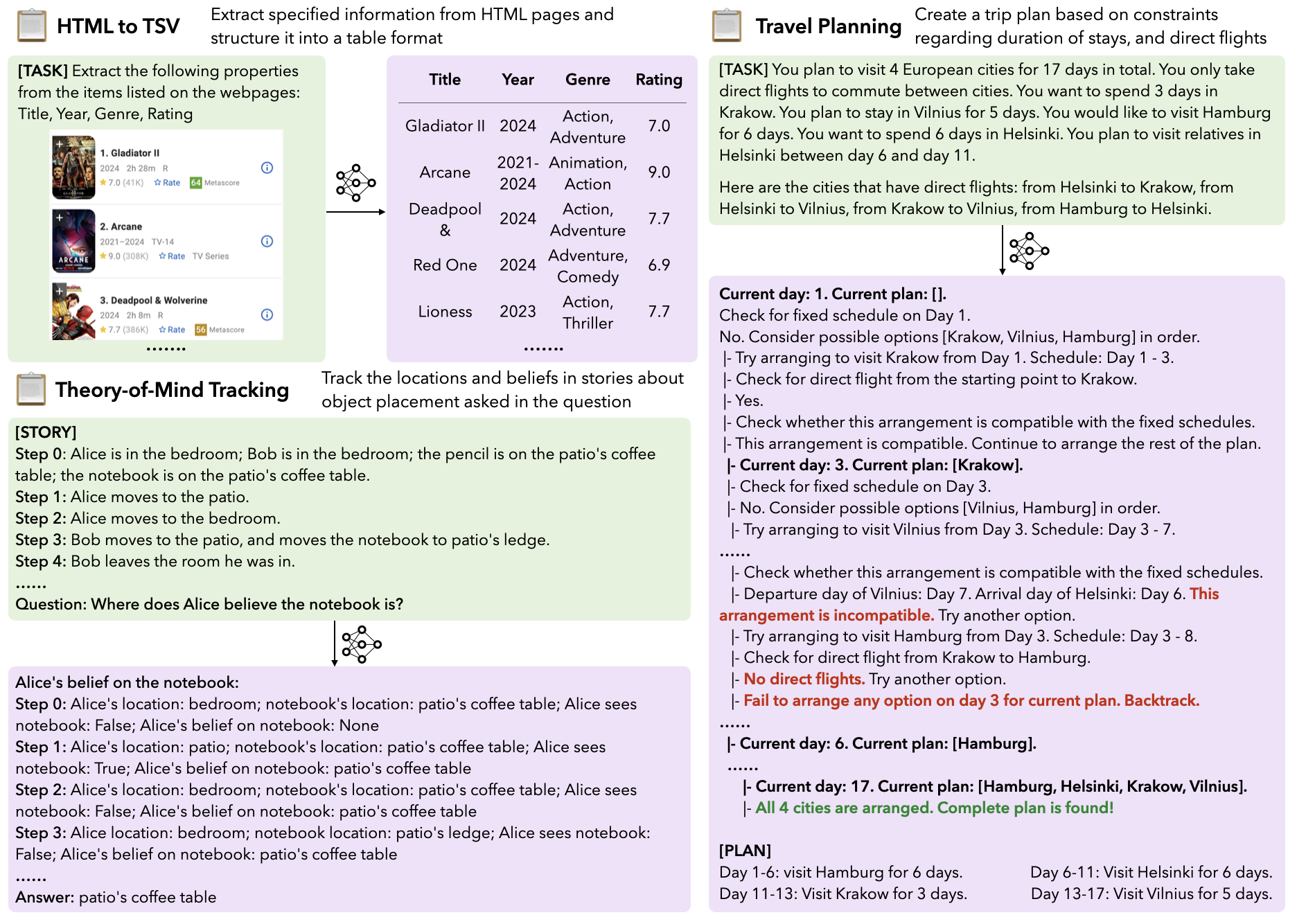
LongProc consists of 6 tasks, each at up to 3 difficulty levels based on the expected output length (~0.5K, ~2K, ~8K tokens). The dataset is organized into 17 subsets (configs), each containing a single test split.
| Task | Description | Configs | Total Examples |
|---|---|---|---|
| HTML to TSV | Extract information from HTML pages into structured TSV tables | html_to_tsv_0.5k, html_to_tsv_2k, html_to_tsv_8k |
100 + 189 + 120 = 409 |
| Pseudocode to Code | Translate line-by-line pseudocode into C++ code | pseudo_to_code_0.5k, pseudo_to_code_2k |
199 + 200 = 399 |
| Path Traversal | Trace a route between cities in a directed graph where each city has one outgoing edge | path_traversal_0.5k, path_traversal_2k, path_traversal_8k |
200 + 200 + 200 = 600 |
| Theory-of-Mind Tracking | Track object locations and agent beliefs through multi-step stories | tom_tracking_0.5k, tom_tracking_2k, tom_tracking_8k |
200 + 200 + 200 = 600 |
| Countdown | Search to combine numbers with arithmetic operations to reach a target | countdown_0.5k, countdown_2k, countdown_8k |
200 + 200 + 200 = 600 |
| Travel Planning | Search to construct a trip plan satisfying duration and flight constraints | travel_planning_2k, travel_planning_8k, travel_planning_icl_examples |
769 + 239 + 4 = 1012 |
from datasets import load_dataset

# Load a specific task + difficulty
ds = load_dataset("PrincetonPli/LongProc", "countdown_0.5k", split="test")
print(ds)
# Dataset({
#     features: ['nums', 'target', 'solution', 'search_steps', 'demonstration', 'solution_text', 'num_search_tokens'],
#     num_rows: 200
# })

# Load another config
ds = load_dataset("PrincetonPli/LongProc", "html_to_tsv_2k", split="test")
print(ds[0].keys())
# dict_keys(['task_id', 'website_id', 'task_topic', 'task_description', 'gt', 'tsv_header', 'filtering_instruction', 'html_content'])
| Field | Type | Description |
|---|---|---|
task_id |
string | Unique identifier for the task instance |
website_id |
string | Identifier for the source website |
task_topic |
string | Topic of the webpage (e.g., "electronics", "books") |
task_description |
string | Description of what properties to extract |
gt |
string | Ground truth TSV output |
tsv_header |
string | Header row for the TSV output |
filtering_instruction |
string | Additional instructions for filtering rows |
html_content |
string | Full HTML content of the webpage (inlined) |
| Field | Type | Description |
|---|---|---|
problem_id |
string | Unique problem identifier |
pseudocode_lines |
list[string] | Pseudocode description, line by line |
code_lines |
list[string] | Ground truth C++ code lines |
testcases |
list | Test cases for validation |
| Field | Type | Description |
|---|---|---|
context_nl |
string | Natural language description of the city graph |
question_repr |
list[string] | Source and destination cities |
answer_nl |
string | Ground truth route in natural language |
| Field | Type | Description |
|---|---|---|
story_components |
string | Components of the story (agents, objects, rooms, containers) |
story |
string | The multi-step story |
question |
string | Question about an agent's belief about an object's location |
solution |
string | Step-by-step solution trace |
answer |
list[string] | Final answer(s) |
| Field | Type | Description |
|---|---|---|
nums |
list[int] | Four input numbers |
target |
int | Target number to reach |
solution |
list[string] | Sequence of equations forming the solution |
search_steps |
float | Number of search steps in the ground truth trace |
demonstration |
string | In-context demonstration of the search procedure |
solution_text |
string | Full solution text including the search procedure |
num_search_tokens |
int | Number of tokens in the search procedure |
| Field | Type | Description |
|---|---|---|
id |
string | Unique problem identifier |
ground_truth_cities |
string | Ordered list of cities in the ground truth plan |
ground_truth_durations |
string | Duration of stay for each city |
num_cities |
int | Number of cities to visit |
total_days |
int | Total number of trip days |
constraints |
list[object] | Constraints with city, type, start/end days, num_days |
connected_cities |
list[list[string]] | Direct flight connections between cities |
original_question_text |
string | Original problem statement |
disambig_question_text |
string | Disambiguated problem statement |
ground_truth_plan |
string | Complete ground truth trip plan |
estimated_output_tokens |
int | Estimated output length in tokens (not present in ICL examples) |
The travel_planning_icl_examples config contains 4 in-context learning examples that share the same schema but without estimated_output_tokens.
The prompt templates below are used to construct the input prompts for each task. Placeholders in {braces} are filled from the corresponding data fields.
[TASK]
Your task is to extract specific information from an HTML webpage and output the extracted
information in a tsv file. You will be first given an HTML webpage. Then, you should follow
the specific instruction provided later and output the tsv file following the format provided
in the instruction.

[INPUT WEBPAGE]
```html
{html_content}
[TARGET INFORMATION] Based on the HTML webpage above about {task_topic}, extract the following properties from the items listed on the webpage: {task_description}{filtering_instruction}
[OUTPUT FORMAT] Structure your output in TSV format such that each row of your output corresponds to the aforementioned properties of an item and each property is separated from each other by a tab "\t". Your output should be in the following format:
{tsv_header}
{Your TSV output}
[IMPORTANT NOTES]
Now, extract the information from the HTML webpage above and follow the output format above in your answer.
</details>

<details>
<summary><b>Pseudocode to Code</b></summary>
[TASK]: You will be given lines of pseudocode, your task is to write the corresponding C++ code. The pseudocode will provide detailed description of the c++ code line by line. The pseudocode is garanteed to be correct and complete.
[INSTRUCTION]: The following libraries are already included in the code.
#include <cstdio>
#include <iostream>
#include <vector>
#include <algorithm>
#include <numeric>
#include <cmath>
#include <cstring>
#include <set>
#include <map>
#include <queue>
#include <stack>
#include <list>
#include <fstream>
#include <climits>
#include <cassert>
#include <iomanip>
#include <sstream>
#include <bitset>
using namespace std;
Do not include them in your code again. Please surround your code with cpp and markers.
Note that the code should correspond to the pseudocode line by line.
Where {pseudocode} is constructed by joining pseudocode_lines with newlines.
[TASK]
In a completely hypothetical world, there are a number of cities. Each city has a one-way
connection to only one other city via a specific transit method (bus, train, plane, or ferry).
Your task is to provide a route from a city to another city. You should follow the specific
instruction provided later and output the route following the format provided in the instruction.

[IMPORTANT NOTES]
- All connections are one-way. If city A is connected to city B, you can travel from A to B,
  but not the other way around.
- Because each city is connected to only one other city, so there's only one possible route.
  To find the route, you can simply start from the starting city, identify the next city it's
  connected to, and repeat the process until you reach the destination city.
- Please follow the exact format specified below when outputting the route.

[OUTPUT FORMAT]
Please mark the route with <Route> and </Route> tags. The route should be in the following
format, where one line is one step of the route:
<Route>
From <CITY_NAME>, take a <TRANSIT_METHOD> to <CITY_NAME>.
...
From <CITY_NAME>, take a <TRANSIT_METHOD> to <CITY_NAME>.
</Route>

[EXAMPLE]
...

[PROBLEM]
{context_nl}

Now find the route from {src_city} to {dst_city} based on the information above.
Where {src_city} and {dst_city} come from the question_repr field.
[TASK]
You'll see a story about object placement. Each story involves four components: Agents,
Objects, Rooms, and Containers. Given a question about an (agent, object) pair, your task
is to track the locations and beliefs in stories about object placement asked in the question.

[APPROACH]
You will solve the problem by tracking the location of the agent, location of the object,
and the agent's belief of the object.
1. Initial Setup: set up agent's starting location, object's starting location, agent's
   initial belief on the object's location. Note that if an agent does not see an object
   at the start, their belief on the object is None.
2. Then, track step-by-step:
   - If a step involves that the agent moves to another room, leaves a room, or enters a
     room, you should update the agent's location.
   - If a step involves the object of interest moving, you should update the object's location.
   - To keep track of the agent's belief on the object: If the agent and the object are in
     the same room, the agent can see the object, so the agent's belief will reflect the
     true location of the object. If the agent cannot see the object, the agent's belief
     will remain unchanged until the agent sees the object again.
3. Format your output exactly as shown in example answers below.

[EXAMPLE STORY / QUESTION / ANSWER]
...

[PROBLEM]
Read the following story and answer the question.

[STORY]
{story}

[QUESTION]
{question}

[YOUR ANSWER]
[TASK]
You will be given four numbers and a target number, your task is to find a way to use all
four numbers exactly once, along with the basic operations (+, -, *, /), to reach the
target number.

[RULES]
- You can use each number exactly once.
- You can use the four basic operations (+, -, *, /).
- The intermediate results must be integers (no decimals allowed).
- The intermediate results must be positive.
- The intermediate results will not exceed 2000.

[APPROACH]
We will solve the problem by searching. Starting from a given set of four numbers, we will
follow this search process...

[EXAMPLES]
{demonstration}

[Problem]
Numbers: {nums}
Target: {target}
The {demonstration} field is provided per-example and contains worked examples of the search procedure. {nums} comes from joining the nums list.
TASK:
Your task is to create a trip plan based on given constraints regarding cities to visit,
duration of stays for each city, and available direct flight connections.

REQUIREMENTS AND NOTES:
- You will arrange a trip plan for visiting several cities for a specified total number of days.
- You will be informed about how long we will stay in each city. Some cities have fixed
  schedules because of pre-planned events. You have to follow the fixed schedules for those
  cities. Cities without fixed schedules need to be arranged according to the constraints.
- Only direct flights may be used to travel between cities.
- When calculating the duration of a stay in a city, count both arrival and departure days
  as full days.

APPROACH:
We will solve the problem by searching...

EXAMPLES:
{demonstration}

YOUR TASK:
{problem}
The {demonstration} is constructed from the travel_planning_icl_examples config. {problem} comes from disambig_question_text (or original_question_text).
We recommend using the LongProc GitHub repository for data loading and evaluation:
from longproc.longproc_data import load_longproc_data

data, eval_fn = load_longproc_data("countdown_0.5k")
# data: list of dicts with 'input_prompt', 'reference_output', 'item'
# eval_fn: task-specific evaluation function
For large-scale evaluation, we recommend the HELMET framework with the LongProc Addon.
@inproceedings{ye25longproc,
    title={LongProc: Benchmarking Long-Context Language Models on Long Procedural Generation},
    author={Ye, Xi and Yin, Fangcong and He, Yinghui and Zhang, Joie and Yen, Howard and Gao, Tianyu and Durrett, Greg and Chen, Danqi},
    journal={Conference on Language Modeling},
    year={2025}
}
@article{arborist,
    author = {Li, Xiang and Zhou, Xiangyu and Dong, Rui and Zhang, Yihong and Wang, Xinyu},
    title = {Efficient Bottom-Up Synthesis for Programs with Local Variables},
    year = {2024},
    journal = {Proc. ACM Program. Lang.},
    volume = {8},
    number = {POPL},
}

@inproceedings{spoc,
    author = {Kulal, Sumith and Pasupat, Panupong and Chandra, Kartik and Lee, Mina and Padon, Oded and Aiken, Alex and Liang, Percy S},
    booktitle = {Proceedings of the Conference on Advances in Neural Information Processing Systems (NeurIPS)},
    title = {{SPoC: Search-based Pseudocode to Code}},
}

@inproceedings{gandhi2024stream,
    title={{Stream of Search (SoS): Learning to Search in Language}},
    author={Kanishk Gandhi and Denise H J Lee and Gabriel Grand and Muxin Liu and Winson Cheng and Archit Sharma and Noah Goodman},
    booktitle={First Conference on Language Modeling},
    year={2024},
}

@article{natplan,
    title={{NATURAL PLAN: Benchmarking LLMs on Natural Language Planning}},
    author={Zheng, Huaixiu Steven and Mishra, Swaroop and Zhang, Hugh and Chen, Xinyun and Chen, Minmin and Nova, Azade and Hou, Le and Cheng, Heng-Tze and Le, Quoc V and Chi, Ed H and others},
    journal={arXiv preprint arXiv:2406.04520},
    year={2024}
}
For questions, feel free to open issues on the GitHub repository or email xi.ye@princeton.edu.